Friday, October 30. Amtrak to Baltimore Airport. Rental car to Frederick. Finding free parking twenty minutes away from the museum to avoid ridiculous fees, definitely an idiosyncrasy of mine. Walk the scenic streets. First impressions. There are a lot of churches in Frederick. I suppose I should put on my crypto-Jew makeup.
I am in Frederick for the Museum of Civil War Medicine. It’s late morning at the time of my arrival, quiet in the exhibit rooms, no visitors, few volunteers. The seemingly only volunteer on site begins to talk to me. His name is Bob. He asks where I live. The whisper of Brooklyn incites his memory. He grew up in Forest Hills, and he remembers the despair of the neighborhood, the upfront, full-frontal grisliness. “We lived on the good side of the street,” he says.
I respond by raising the one reason Brooklyn appeals to me. Integration. I want to be surrounded by different languages, different cultures, various and competing belief systems, skin colors across the spectrum, religious diversity, and people who want all of it, people who want the contrast of the world. I have no idea if God exists. I don’t know why we capitalize. For the past decades I’ve been writing a book series, questioning our grammar on the grounds of racism. The uppercase reaches deep into the undulations of our culture. We capitalize White House. We capitalize Robert E. Lee. We capitalize George Washington. Why are we offering slavers the same grammar reverence as God? If there is a God, or was a God, why would He sanction slavery?
Bob lived on the good side of the street.
I enter the two floors, six rooms of the museum. I am immediately struck by these young men, boys, who volunteered for war. There’s an exhibit, early in the museum adventure, that talks about medical conditions and why a soldier might be sent home. Habitual drunkenness was a reason for dismissal from the army. Syphilis and tapeworm were not. Maybe medical science of the 19th century saw tapeworm as a kind of inoculation for syphilis? Or vice versa?
Neither the Union nor the Confederacy inoculated the Black population. When Black men became soldiers in the Union, essentially post-Emancipation Proclamation, smallpox ran rampant. Smallpox killed more Black soldiers than bullets.
Abe Lincoln did not capitalize the Confederacy. Rather, he thought the title bestowed legitimacy, so he went with another referent. rebels, always decapitalized. Maybe, latently, Abe clued into the great grammar problem?
Epilepsy was a reason for dismissal from the army. Chronic asthma was a reason for dismissal. Flatfeet meant fighting. During the Vietnam era, flatfeet would get the recruit a discharge. Those soldiers were boys, too.
The number one killer of Civil War soldiers was diarrhea. Second was hospital gangrene. Let’s talk the true history of anesthesia. Ether and chloroform were born in antebellum America. Surgeons used both chemical compounds during procedures, though they preferred chloroform. Ether took too long to knock out the patient. Ether was like the heavy sleeper, needing to awake, constantly hitting the snooze alarm on the alarm clock.
It’s a reverse metaphor. Lincoln was sort of a reverse metaphor. He decapitalized rebels. He believed in white supremacy.
The dominant image we have today of Civil War surgery revolves around a soldier biting down on a bullet after taking a healthy swig of whiskey for shock and courage. Amputation was a life saver. Amputation was vaccination. Sawing off a limb, particularly in the immediate hours after the damage, helped to alleviate what typically followed bullet wounds. Gangrene.
The statistics are startling. During the four years of war, some 700,000 soldiers died. Over two-thirds of those deaths can be blamed on infection. Battlefield surgery was far more effective than hospital surgery.
Treatments for hospital gangrene sound familiar to the Covid era. Treatments like proper spacing between patients. Treatments like washing hands. Treatments, as if inspired by the first Trump administration, like whiskey consumption, and turpentine slathered on skin, and nitric acid digestion.
Imagine the results. It would be like spraying chlorine or alcohol on your skin to treat Covid, or drinking down bleach, or popping Hydroxychloroquine tablets. In fact, the historical and medical records indicate that Hydroxychloroquine saw a sudden rise during the first CoronaSpring. Note the double capitalization. The reasons eventually materialized. President Trump championed the drug as an elixir. Trump being Trump, he couldn’t pronounce the name. Trump being Trump, he didn’t possess the patience to learn the pronunciation. Trump being Trump, he created a nickname. “Hydroxy” came into the American vernacular. Nobody in the Hydroxychloroquine community uses the term. The referent revolves around an acronym: HCO. The acronym is printed on each and every pill.
In recent times, HCO became a key drug in combating arthritis/rheumatism. During the Civil War, soldiers were sent home from the army for arthritis. After fleeing from her plantation in Arlington for Richmond, Mary Anna Custis Lee, wife of Robert Lee, suffered terribly from rheumatoid arthritis. She never became the face of the Confederacy due to her affliction. Like the HCO pill, Lee went by an acronym. MACL.
Julia Grant, wife of Ulysses Grant, never became the face of the Union, either. She was born with strabismus. She appeared cross-eyed. Almost all historical photographs position Julia in profile. A photograph of Julia Grant’s full face is as rare as a photograph of FDR in his wheelchair, or MACL in her wheelchair. Julia Grant owned nearly as many slaves as MACL. Julia Grant took her favorite slave, Jule, to Vicksburg to visit her husband during the siege. Note the names.
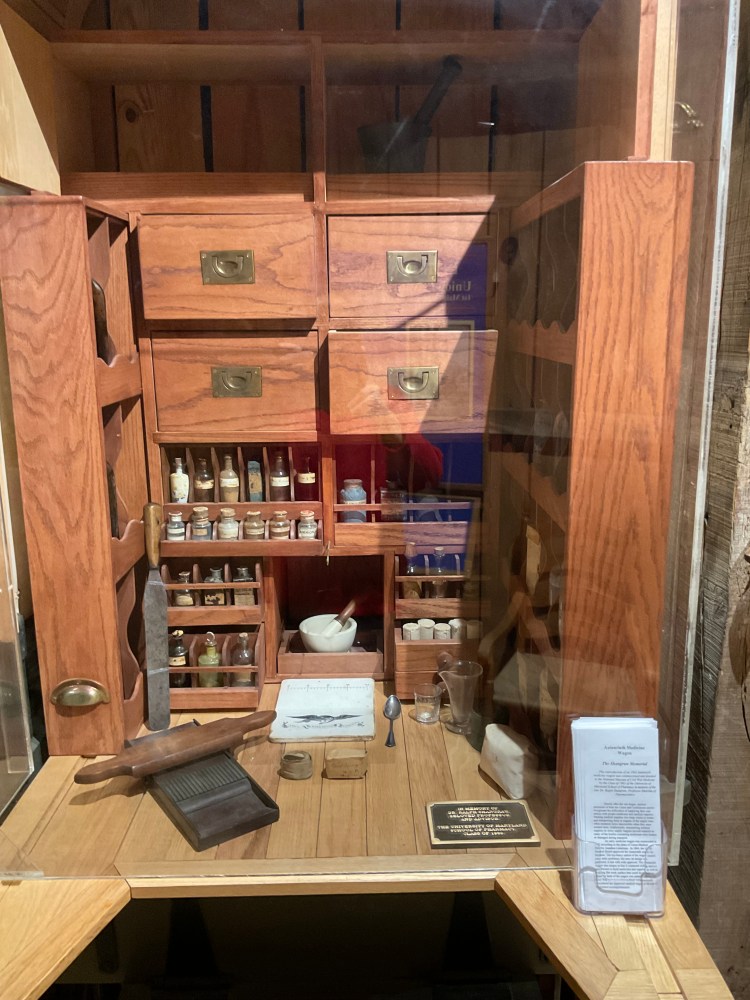
Check out the medical kit of the surgeon. A separate kit carried saws and knives and other instruments used for surgery. The museum talked nothing about sterilization habits. I believe the surgeons wiped clean their saws with a used towel after cutting off a soldier’s leg, then went to the next patient.
There was a young surgeon named Charles Leale. This is a true story. On the evening of April 14, 1865, he went to Ford’s Theatre. According to his testimony, he saw Lincoln slump from the effects of the bullet entering his brain. He tried to make his way into the private box, but security denied him. There was no security just minutes before when Booth pulled the trigger.
With help, Leale climbed over the balcony from the stage, again according to his testimony. He found Lincoln slumped over, Mary Todd Lincoln trying to keep her husband’s body upright. Leale did a quick reconnaissance of Lincoln’s body, searching for the bullet. He found no entrance wound. Then his reconnaissance took him to the head. With unwashed hands, he probed the back of Lincoln’s brain.
Booth was right-handed. Blindness in the right eye was cause for dismissal from the army. All gun training used the right eye for sightlines. Blindness in the left eye was not cause for dismissal.
Let’s get back to the surgeon’s kit. As a boy, I watched my father come and go from our family home. He was a pediatrician, and he carried a black leather medical bag. In my memory, my father had one bag throughout his medical practice. One bag for decades and decades of service. In my memory, the leather bag was severely scuffed, peeling, always falling apart. When the bag finally fell apart, he went to a daypack.
How the surgeons got their kits from one battlefield to another is a story all its own. It took six horses to pull the cannons from battle to battle. How many horses did it take to pull the surgeons’ kits?
My father’s black leather bag had two identical handles for carrying. Is there a sort of white supremacy against left-handers?
A felon was a reason for dismissal from the army. Both the Union and the Confederacy ostensibly fostered the moral compass of the soldier. What other war, in the entire history of warfare, feigned such righteousness? Did either side succeed?
Let’s end this reconnaissance with another photograph from the museum.
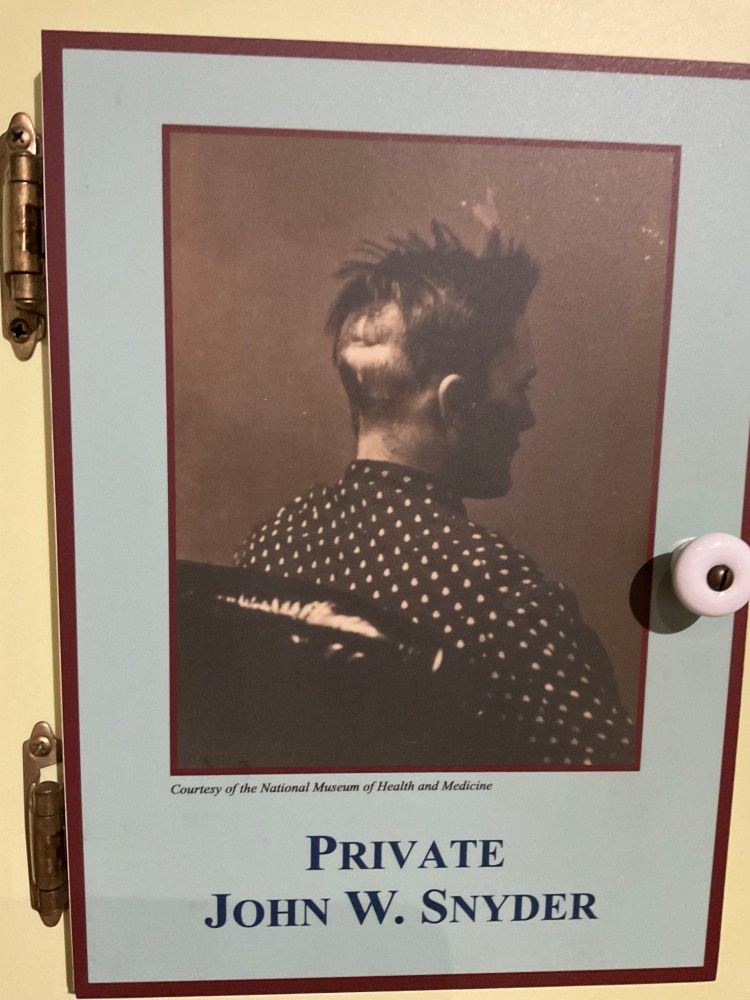
The soldier’s name was John W. Snyder of Pennsylvania. The war placed him in Petersburg, Virginia, during the battle that would effectively end the Confederacy. The date was April 1, 1865. A bullet smashed into the back of his brain.
A few days later, Abe Lincoln began the sea journey from Washington to Petersburg. In the first book of my five-part series (only two have been completed, with a third coming in 2027), I asked a question never really addressed by historians. Why did Lincoln travel to battlefields in the immediate aftermath of the fight, with bodies littering the ground? What was in his psychology that he needed to witness the devastation?
Lincoln arrived in Petersburg on April 3, the very same day that Grant’s army occupied the city. If he visited Private John Snyder in a field hospital, there is no record. Private Snyder survived the injury, as evidenced by the photograph. He was moved to a hospital in Washington, D.C. On April 13, surgeons removed a fragment of bone.
Note the date. One day later, Lincoln suffered a similar injury. There was no security guarding the door to the private box. Dr. Charles Leale sat in the orchestra section below. Snyder would live the rest of his life with impaired vision. Lincoln’s life ended hours later. Bob lived on the good side of the street. I live in Brooklyn for reasons of integration. Why do we capitalize the proper names associated with the slaveocracy?


Enjoyed reading this. Who has always ran the show…
LikeLike