A Nonfiction Novella
I spent too much time at Gettysburg. I think George Saunders had Gettysburg in mind when we wrote his story, “Civil WarLand in Bad Decline.” No doubt, the battlefield is an anti-amusement park of sorts, but the scope and epic make for must-see horror tourism.
I departed after dark, set for the four-hour drive to Richmond. Except I tired as the miles passed. I’m not young anymore. I used to do 10-hour days behind the wheel, sleep for an hour, and push on for another five. Those days are decades gone.
I didn’t make the city and my arranged Airbnb accommodation. I pulled over at a rest stop. I brushed my teeth. I bought a small bag of pretzels from the vending machine. A strange order, I know. I started to read in the car as relaxation, but my eyelids grew heavy. I dozed. An hour passed. I awoke in a start, feeling unsafe, feeling vulnerable. The feeling dissipated as I quickly gained my bearings. I made a (sleepy) decision: to spend the night in the car.
A cold Virginia evening, my bright green parka pseudo-protecting me from the chill, dozing, unable to stretch out in the rented Jeep, everything hurting, dozing, vulnerable-sleeping, waking, turning on the car engine to blast the heat, dozing.
These are the vagaries of travel. Decisions get made, or not made, and the traveler finds a way to go along with the consequences. These consequences meant an achy body in the (early) morning, achy and fatigued.
I slept on and off through the night, vulnerable-sleep, maybe an hour at a time. Finally, I decided to push on. I started the engine with the press of a button. Still very dark, and with the sun rising early thanks to the end of Daylight Savings. I drove Route 15 to Interstate 64. I cut east. Richmond appeared around first morning light.
At first light, Day 3 of the Gettysburg battle, Robert E. Lee wanted the flanks of his army to attack. Revision suggests that his subordinate, General Longstreet, made the decision not to attack, fearing failure. A counter-narrative, perpetuated by Northern revisionists, identified a pre-dawn attack. General Meade aimed for the middle ground.
Revision or not, the consequences meant death. Decisions get made, or not made, and the soldier finds a way to go along with the orders. These are the vagaries of war. Of the 5,500 soldiers ordered to participate in Pickett’s Charge, half the men were either cut down, wounded, or deemed missing. Half! A massacre. All of Pickett’s field commanders died in the charge.
At around eight a.m., I arrived at a park called Westover. The place was semi-deserted, and as that Sunday passed, I saw skateboarders, dogs with their people, a kite flier. The kite string got tangled in the power wires, high above and supported by wooden poles. A realization hit. I hadn’t seen power wiring in decades. Back when I could drive all day. Richmond feels like the past.
An hour early for my tennis date, I found plenty of time to try to alleviate the ache. I did some stretching. I drank down the largest coffee on planet earth, purchased from 7-Eleven. Bigger, of course, doesn’t mean better. I did my yoga.
Nothing helped. Here’s a life lesson. Fifty-eight-year-old bodies should not spend the night in cars.
My coach for the day, Junie Chatman, arrived late. I said nothing, but later, over dinner, I brought up my wait time. “Punctuality is a gift from God,” he replied. “My people aren’t given the gift.” I answered, “Either are mine.”
He didn’t ask the follow-up. I didn’t offer unsolicited. But let’s be real. Both Jews and Blacks have inside words for tardiness. Neither are flattering, both are incendiary, insider words, not for public consumption. I did a comparison for him. “The outside world creates these terrible tropes for us. Jews are miserly, ‘Don’t Jew me down.’ Blacks are dumb. You’d rather eat watermelon than think. There used to be a time when Black quarterbacks were considered not intelligent enough to play the position.”
Junie didn’t respond to my comparison. Instead, he chewed on okra gumbo. Overchewed, actually.
First impressions of Junie on the court went to his clothing. Not quite fifty degrees and he wore summer whites, no second layer. “You look ready for Wimbledon,” I said. “I played a couple of qualies there,” he answered. “Never won a match.”
“Qualites” means qualification matches, the pre-tournament the week before the big dance, win four matches on successive days and the player receives a first-round date with a top-ranked player. Junie spent six years on the tour. He was born in 1956, and he played the likes of Borg, Connors, and McEnroe. He never played his hero, Arthur Ashe.
“Thank God,” he said of that non-meeting. “Skinny was 13 years older than me. We both grew up here, in Richmond, on the same courts. Richmond bros, we are, and I followed his every move. When he won New York, I cried. Greatest day of my life.”
New York, meaning the U.S. Open, Flushing Meadows, the main show court now called Arthur Ashe. I detoured around the nickname – seems self-evident with one look at a photograph of Ashe’s body – to make a comparison. “Sort of like when Obama won the presidency,” I said. He threw me a look, like when you need to serve an ace and you double fault. As if I didn’t understand, he clarified: “Barack has nothing on Bones.”
The nicknames were news to me. In my worldview, “Bones” means McCoy, Star Trek doctor in the original. “Damn it, Kirk, I’m a doctor, not a tennis player.”
Later, over dinner, I circled back to the connection. “Would you rather vote Ashe or Obama for president?” I asked. He answered, “Bones, but I did vote for Barack. First time in my life that I voted.”
“Barack,” not Obama. Would a study show that Black people refer to him by first name, an insider name? Would Junie refer to Clinton as “Bill”?
In 2008, when Obama won his first presidential election, Junie was in his early 50s. Maybe to vote was a mid-life crisis? “Why didn’t you vote before?” I asked. He answered, “Jim Crow. Disenfranchisement.”
Second impressions of Junie on the court went to his name. He isn’t a Chatman. He’s a Terseman. His Google profile identifies him as warm, gracious and gentle, a chatterbox. I questioned the talking fixation. “I’m 70 now,” he said, “and I don’t have any more time for talk.”
We moved in between the lines and started by rallying, the ball going back and forth over the net. Third impressions of Junie on the court went to his athleticism. He moved gracefully. He might not be fast anymore. He might not be able to vigorously attack the net. But he understood angles. He understood small steps. He’s not thin anymore. (His nickname used to be Bones, too.) He can’t grow an Afro like he did in the 1970s, a stylish mustache, thick eyebrows. His black skin has faded, ever so slightly. His kinky hair is gray. But he still has freckles all over, and his legs are ripped from jumping into his serve, and he bleeds Richmond to the core. “Did you ever think about living anywhere else?” I asked him at some point in our day, maybe at dinner. “Where?” was his response.
We hit for a good half hour, just feeling the shoes on the court, the ball on the strings, the breath. I love tennis for this zone. It’s all right in the moment, and it feels unique to tennis. Team sports rely on communication, on talk. In basketball, the coach yells for more talk from his players. Life feels the same way. In tennis, there’s no room to open your mouth, other than to breathe.
Junie didn’t bring a video recorder. Junie didn’t bring a ball machine. “Don’t like the noise,” he shared of the latter. Junie has never been on Google. “What would I learn?” he asked.
In my tennis life in Brooklyn, I hired a coach. This occurred during the first CoronaSpring. When the tennis courts and other public athletic fields opened, I set a new goal for myself: to win the French Open. I did some Googling. The oldest winner of the French was a Spaniard named Andres Gimeno. That was back in 1972. He was 34 years old. Two years after the first CoronaSpring, another Spaniard, the great Rafael Nadal, became the oldest winner. He was 36 years old, and two days. Why are the days significant? The next year Novak Djokovic passed him by eighteen days. At the time of the first CoronaSpring, I was 52 years old.
My coach’s name was Juan, and we played once a week, every Monday, weather permitting. We played outdoors, on clay courts, with the George Washington Bridge in sight. I dreamed of the Eiffel Tower.
Juan was born in San Juan. The name connection gave me a forever laugh. “Juan from San Juan” became trash talk. He had no retaliation. Brian from? He would yell, “Get in the t-zone.” He knew I couldn’t talk and play at the same time.
In the planning stages for our tennis day, Junie gave me a list of musts to bring. Water, sunscreen, a towel, a hat, bananas, cracker with salt, black chalk, cones, rubber racquetballs, Calamine lotion. He brought only his Wilson racket. No cover.
“What’s the Calamine for?” I asked. “You’ll see,” he answered. “Why racquetballs?” I asked. “Just make sure they’re bright bright,” he answered. I found a gorgeous shade of blue.
Items led to location. Junie set the date for Westover. “Why not Byrd Park?” I asked. “Didn’t you basically come of age there?” I’d learned that tidbit on Google. “Yes,” he answered, “but you want to play all day. At Byrd you’ll play an hour. It’s a zoo.” I changed the subject, sort of. “Who was Byrd Park named after?” Junie didn’t seem to hear, or care. Maybe he was just in the zone?
Later, before dinner, I did some Googling. Byrd Park was named after one of Virginia’s elite colonial planters, from the early part of the 18th century. His name was William Byrd, Jr., and the city council of Richmond did him a posthumous honor. In 1907, Byrd Park was born.
The early 20th century saw the rise of KKK power, Black codes, Lost Cause craziness, Woodrow Wilson re-segregation. It’s no surprise that Richmond would name a park after a slaver. In that same year, Richmond added a statue of Jefferson Davis to its collection on Monument Avenue. In 1919, Richmond added a statue of Stonewall Jackson. Only some eighty years later did Richmond begin to address the inherent racism. Richmond added a statue of Arthur Ashe. It’s a moving tribute. Look at Skinny.
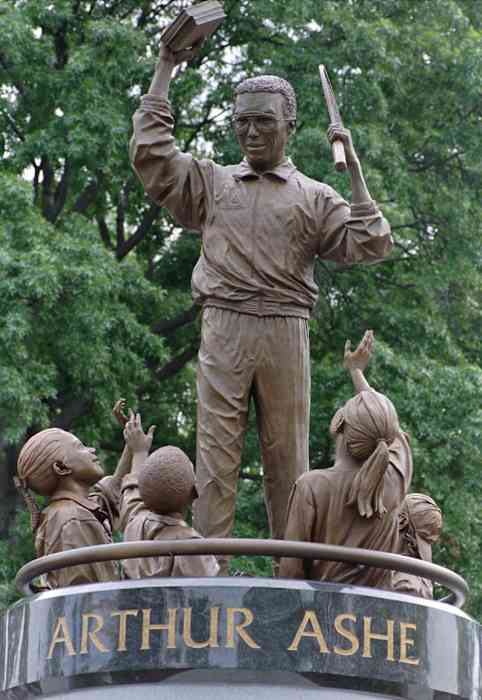
The historical record indicates that William Byrd left extensive diaries and business ledgers documenting his slave ownership, the buying and selling of chattel, punishments inflicted per offense, the routine trips to the Shockoe Slip, where slaves in chains came off the boat, and the Exchange Hotel, a major auction site on the Richmond slave tour. Notably, William Byrd owned a plantation called Westover. Names are not just names. Names are insights.
At dinner that night, at a soul food place called YaYa’s Cookbook, Junie did the ordering. I stood and listened as he ticked off just about everything at the buffet table. Sweet wings, rice & peas, cabbage, mac & cheese, collard greens. The list went on. Oxtails in a tasty reddish sauce, fried fish, okra gumbo, catfish stew.
I didn’t say a word about the bill. But here, in this space, let me say this. The order at YaYa’s Cookbook cost more than Junie’s fee for our tennis day. Well, that’s a slight exaggeration. How did we decide upon Junie’s fee? I suggested a number. Junie didn’t seem to mind. He made one attempt at negotiation. “Does that include dinner?” The question was more of a demand.
Junie crashed into his first course: rice & peas. First impressions of Junie eating. He overchews. Yes, he chews loudly and forcefully, but he really works his teeth and gums. There’s a long, exaggerated effort involved. His chewing is the opposite of his tennis game. On the court, Junie moves like Arthur Ashe, compact, effortless, gliding, quiet. Bones moves like Bones. When eating, he’s loud, obtrusive. It’s a smack talk kind of eating.
Impressions led to a location observation. YaYa’s Cookbook resides on the corner of 17th and Main Street. It was at this corner, some 160 years ago, that President Lincoln and his party passed through on their way to the Jefferson Davis House, which had become the headquarters for the Union’s occupation of Richmond. Davis had abandoned the city days before, and Lincoln was on his way to see the general governor. The man’s name was Godfrey Weitzel. Consider the given name. Godfrey was an atheist. Names are insights.
The dock a few blocks to the west, where Lincoln’s boat landed, no longer exists. There used to be a bridge there, over the James. The Confederacy blew it up during the evacuation order, per military protocol. Independent of military protocol, the Confederacy destroyed much of inner Richmond. The Jefferson Davis House went untouched.
After embarking at the dock, Lincoln, his son Tad, and a couple of Navy men walked 17th to Main. Although early April, the day was hot. Lincoln refused to remove his overcoat. He wanted to look dignified for General Governor Godfrey, presidential. The man did not believe in God.
Lincoln stopped at the intersection and asked for water. Many witnesses heard his request. All along, during the Lincoln party’s advance, Richmond gathered. Mainly Black people gathered, freed by the Emancipation Proclamation, but also white Richmond, too, Confederate Richmond. White Richmond didn’t recognize the Emancipation Proclamation.
There was no YaYa’s yet, so someone fetched the communal pail. Lincoln dipped the cup into the bucket. He drank quickly, greedily. Tad dipped the cup into the pail. He took a sip. Together, they continued their walk, Main to 14th.
Here’s what father and son didn’t see behind them. Black Richmond finished the contents of the communal pail. Black Richmond thought of Lincoln as the Messiah. General Governor Godfrey didn’t believe in God.
Second impressions of Junie eating. He doesn’t drink when he eats. He eats one course, then moves to the second. From rice & peas, he went for mac & cheese. I played with my collared greens. Eventually, I interrupted his banquet to ask a question. “How do you feel about Byrd Park, your childhood spot, celebrating a founding slaver?” He responded, “Welcome to Virginia.”
From the V in Virginia, he chewed on sweet wings. Overchewed, actually.
Junie isn’t wrong. To reach Richmond from southern Pennsylvania, I took the Madison, Monroe, and Lee Highways. In a few days, I will be going over to the plantation of John Tyler, located on the John Tyler Highway. To reach Mount Vernon, visitors travel the George Washington Memorial Parkway.
Let’s get back to tennis. We played for five hours, with breaks added. Junie had the lesson mapped out according to drill. He named the drills after current and former professional tennis players. Some examples: The Chrissy drill, after the great Chris Evert; the Boom Boom drill, after 80s-and-90s-star Boris Becker; the Med drill, after current player Daniil Medvedev; the Agassi drill, after Andre. The list went on.
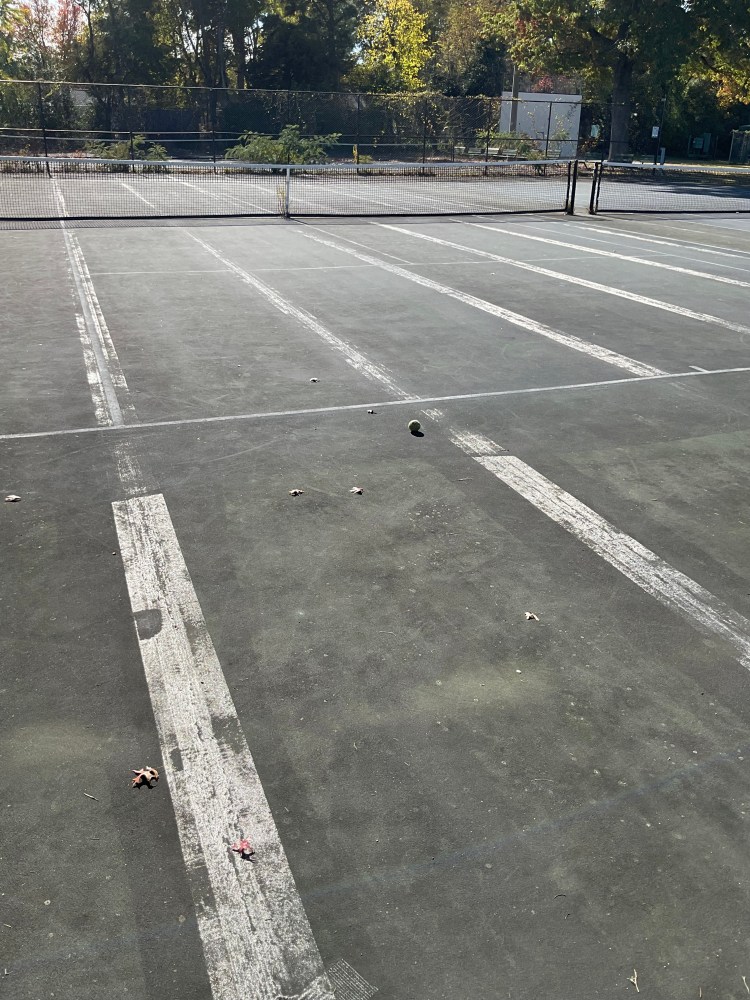
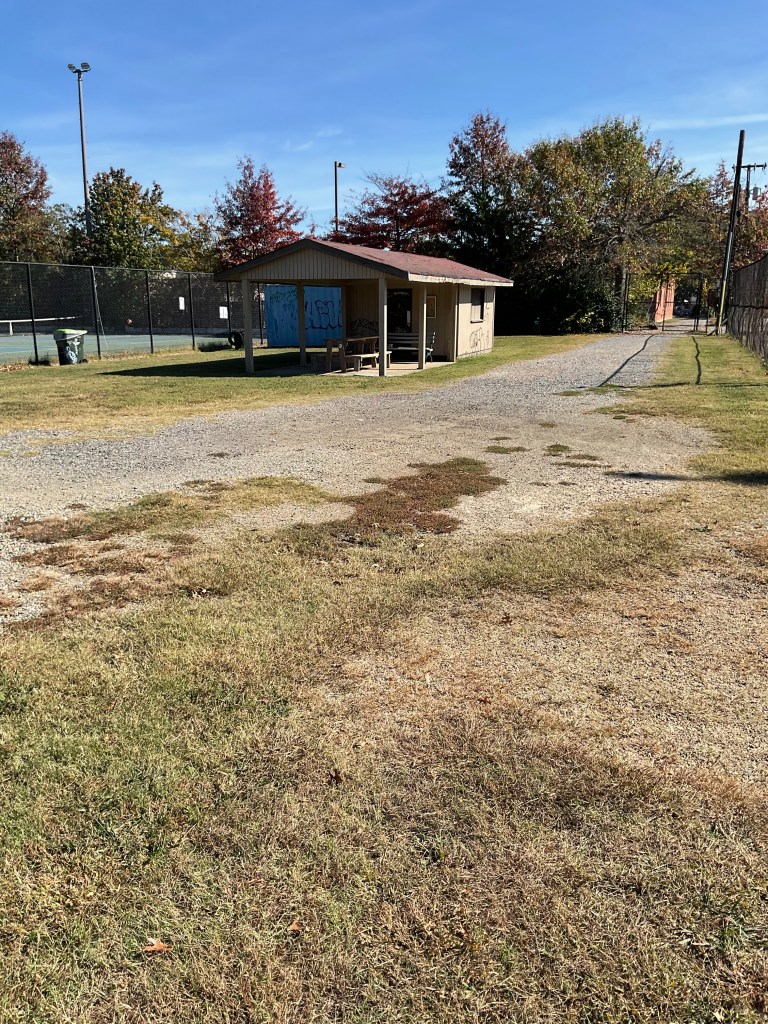
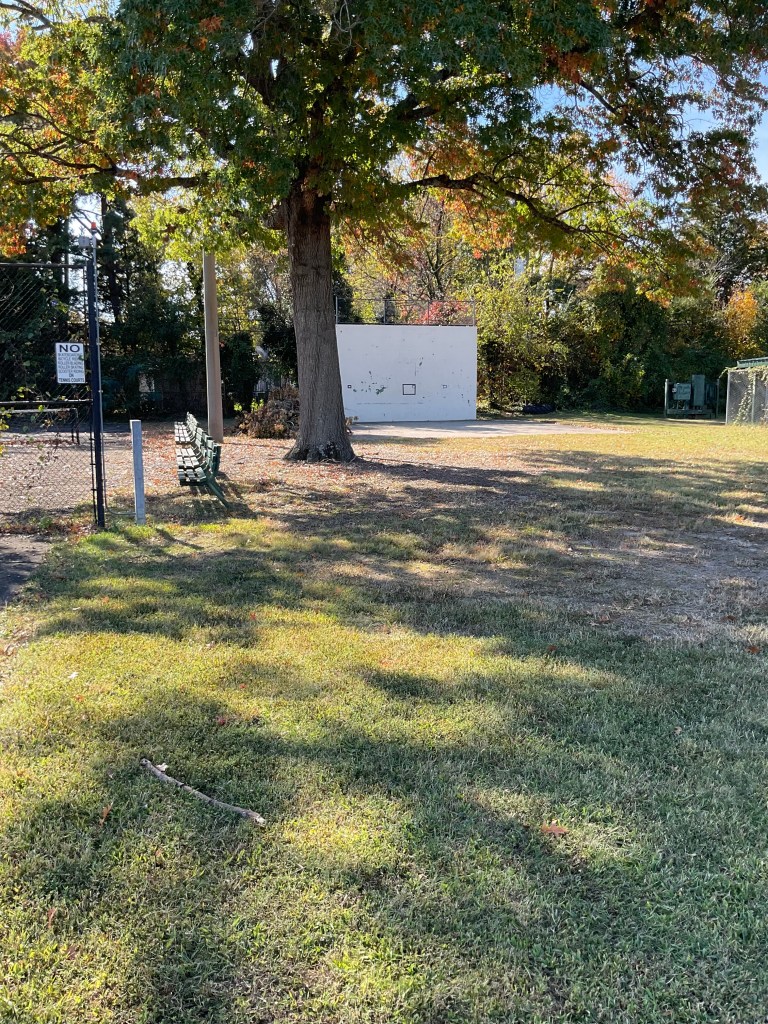
Westover might not be a place for serious tennis, but Junie was right. We played for five-plus hours without inconveniencing anyone. Here are some photos of the grounds, taken by this wanna-be winner of the French Open.
The court:
The clubhouse:
The wall:
The locker room:

Following warm-up, we began the Chrissy drill. Junie placed cones just inside the baseline and the singles sideline. He started by placing the cones three feet from the intersection of the lines. He stood on that side of the net and hit balls to me with his Wilson. I played on the other side, near the baseline. The drill was to hit my shot in between the cone and the corner of the court. “Every time,” Junie informed. “Chrissy was all consistency.”
The drill wasn’t challenging. He began to up the pace, to swing me from side to side. I concentrated on my steps across the court, on seeing the ball, on redirecting my balance and moving out of the corners. Here’s what Junie didn’t know. Juan from San Juan had me do the exact same drill. “Brian,” he would yell, “get into the t-zone.”
In Juan’s vernacular, the Chrissy drill was called the warm-up drill. In Juan’s vernacular, the t-zone meant that feeling of shoes on court, of balls on strings, that feeling of inhale and exhale. The exhale is the opposite of exile. Tennis exhale is as close as we can come to purity of mind.
“Juan from San Juan,” I would shout back, as smack talk. “Get in the t-zone,” he would counter-yell. He knew my zone access had been compromised.
To make the tennis more challenging, Junie closed down the space between the cone and the corner. Three feet became two feet. Two feet became ten inches. The drill became incredibly challenging. “Chrissy never missed,” he said.
Junie never referred to me by my first name. He never pronounced my family name right. “Joseph,” he would say, over and over. I never corrected him. Names are insights. Plus, I was breathing too hard.
When I missed, he would shout, “miss-hit, Joseph.” I persevered through the smack talk.
After twenty minutes, he called for a timeout. Or a changeover, in tennis vernacular. I wiped away the sweat with the towel. I took some water. I ate a banana. “Eat some crackers,” he said. “You need the salt.” Sound advice.
Later, over dinner at YaYa’s, I talked some trash. “I think you had a crush on Chris Evert,” I said. Junie replied, “Come now. A Black man digging a white girl, how do you think that would go?”
Back at Westover, he grabbed the chalk and drew a line parallel to the net, about five feet removed. He placed me on that side of the net. He walked to the baseline on the other end of the court. “Let’s do the Boom Boom drill,” he said.
If you watch any footage of the teenage Boris Becker in the 1980s, you will see him rush the net after every serve. You will see his quick feet. You will see his incredible hands and instincts. You will see him dive for shots. You will see the damage done to his skin by the grass or the hard court. The drill was to serve and volley, to rush the net hard, to stand at the chalk line and take the return, to place the ball into the open court, to never miss, to Boom Boom.
“Miss-hit, Joseph,” he shouted when my serve traveled long. “Miss-hit, Joseph,” he shouted when I didn’t reach the chalk line. “Miss-hit,” he shouted when I dumped my volley into the net. Meanwhile, I noticed that he never flubbed the return of serve. I was bringing the heat, for me, and he was returning perfect every time, right where I should be on the chalkline. His return was low and hard and spinning away from me. Junie touch = Chrissy consistency.
“Jesus,” I grumbled. Was I grumbling at his consistency, or my work rate, or my age and my inability to reach the chalk line, to hit the right shot every single time? Was I grumbling at my expectations of self? My heart was pounding and I wanted to give up. Unlike Boris, I never dove for the ball. I’m not stupid. Becker was a six-time grand slam champion. He never won the French.
“Miss-hit, Joseph,” Junie shouted.
He called for another break. I wiped away sweat using the towel. I drank water. I ate a banana. Later, at YaYa’s, I asked him about his early years in Richmond. What was it like to grow up Black in segregationist Richmond? His first answer went to the banquet. He concentrated on fried fish. I could hear the sounds of teeth crashing into battered bread. I could see the effects of tartar sauce spilling onto lips.
He then embarked upon his second answer: “You don’t really understand stuff when you’re young. Ten, 11, 12, you play tennis all day.” I followed up with, “Were you the only Black player on the court?” He answered, “Yes, but if you could hit a forehand…”
He’s so understated. “If you could hit a forehand” spoke to meritocracy and acceptance. “If you could hit a forehand” spoke to sport as equalizer. My mind went to Jesse Owens. He won four gold medals at the Berlin Games, 1936, an Olympic hiatus of 12 years would follow. When he returned home to the United States, he rode segregated buses.
“Outside of tennis?” I followed up the follow up. He smacked on battered bread. He wiped away tartar sauce. He looked down at the table, at the plates of food remaining. Was he sizing up his next conquest? He replied, “Dudes would ask me to leave because I was Black.”
He’s so understated. “Because I was Black” opened up an entire history, an American journey, 1619 to now. I wanted to dive deep into it, but Junie wanted to eat. The stomach makes a powerful argument. He dug into the next dish. What exactly are oxtails?
Let’s get back to tennis. Junie grabbed the blue racquetballs and the chalk. He walked over to the wall. I followed a step behind.
Please review the photo of the wall above. Note the big square smack dab in the middle of the wall. Now follow a straight line to the viewer’s left, longitudinally. Note a much smaller square. Junie drew those squares on the wall.
“We’re going to start with the Agassi drill,” he said. “Stand at the baseline. Hit the ball against the wall. Move according to the direction of the ball coming back at you. Baby steps.”
If you watch footage of Andre Agassi throughout his long professional career, you will see his movement. Agassi might have been the best foot athlete in the history of the game. He took tiny steps, small redirection steps. He was never off-balance. He never seemed out of rhythm. His steps appeared pigeon-toed. Here’s the incongruity. As a young man, he wasn’t much of a professional. An incredible talent, he downgraded himself by playing in cutoff blue jeans and shirts too big and hair all over the place and big, stylized sunglasses. All that supposed style wasn’t the real Andre. All that supposed style was self-sabotage. The Agassi drill was about instant agility.
“Miss-step, Joseph,” Junie shouted at me. It took me about a moment to realize why we were hitting racquetballs. The hard, round velocity whipping back at me caused instant reaction. Hit, set, move, baby steps, repeat.
“Miss-step, Joseph.” How fast was the whizz and blur of rubber coming back at me? Hard to judge. Maybe 50 mph?
“Miss-step, Joseph.” Maybe 60 mph? For a moment, I wondered why Junie didn’t ask me to bring a radar gun. Maybe 70 mph?
“Miss-step, Joseph.”
Moments later I realized why Junie had asked me to bring Calamine lotion. Behind the wall, removed a few feet, rose an eight-foot high, chain-linked fence. In between the fence and the wall, a small corridor of overgrowth resided, weeds and whatnot. Semi-hidden in the weeds grew the telltale signs of poison ivy plants.
Early into the Agassi drill, I missed the wall. The ball wedged into the weeds. I skipped into the overgrowth to fetch the wayward ball. “Three leaves,” Junie called out.
He’s so understated. The quantity of leaflets exposed the telltale signs.
Moments later, another wayward ball hit the plant life, then shot through a hole in the chain-linked fence. Into the neighboring backyard the ball rolled. There was no way to fetch it, no way to contact those residents. Suddenly, we were down to two racquetballs.
“Miss-step, Joseph,” Junie shouted.
I had this realization. What if I purposefully hit the two remaining balls into the neighboring backyard? Miss-hit, Joseph.
Junie called for a break. I hit the water, hard. I wiped the sweat away with the towel. We resumed. The Agassi drill morphed into the Med drill. If you watch footage of Daniil Medvedev, and you don’t understand his unique strategy and talent, you might question his tactics. Med stands as far behind the baseline as possible. Every court, worldwide, is different. Some courts don’t offer Med the distance he so craves, like Monte Carlo or Rome. Some courts cater to his strategy. The U.S. Open, for instance, where Med won his only major.
On a regulation court, the distance between the net and the baseline is 39 feet. At the Arthur Ashe Court at the U.S. Open, the distance between the net and the back wall is 64 feet. That ain’t skinny.
At the wall at Westover, the distance between the wall and the end of the cement reaches 60 feet, according to my unofficial count. Step after step.
“Stand where the cement meets the grass,” Junie commanded. “Whale on the ball. React.”
I did as commanded. I heard the familiar refrain. “Miss-step, Joseph.” But something skillful occurred, and I began to adapt to the drill. By the time Junie changed things up, I was standing two or three feet into the grass. “Is this what Wimbledon feels like?” I shouted.
Junie didn’t answer my smack talk. Instead, he ordered me to aim for the big square, smack dab in the middle of the wall. “I don’t want to see chalk on the ball,” he shouted.
The alteration proved hit or miss, literally. If this were a low-budget, high-art film about one man’s search for meaning through tennis, we would have arrived at the rising action. The wall a monster, a behemoth. The character standing some 65 feet from the wall, winding up forehands and whaling as hard as can be, racket low to high, very little backswing. The ball missing the square by a hand size. “Miss-step, Joseph,” the character named Junie shouting. The character slashing at a one-handed backhand, very little backswing, an abrupt flick of the wrist, the elbow bending and the racket ending up near his head. The ball missing the square by a fingernail. “Miss-step, Joseph.”
The suspense building. Repeat the action above. “Miss-step, Joseph.”
The climax happening when the rubber ball nails the center of the square. No chalk flying. The shade of beautiful blue unmarked. Then, something skillful happening and the character beginning to hit inside the square with regularity. The scene ending with accomplishment, self-satisfaction.
I have to say, looking back at the scene, I felt joy. I was impressed. What began at under ten percent, with frustration at that square and my shots flying everywhere but, became twenty percent, jumped to forty percent, landed at seventy percent.
Junie wasn’t impressed. “Miss-step, Joseph,” he shouted at the thirty percent gone outside the square.
Of course, this wasn’t a movie. No real rising action. No climax. Junie changed things up. “Go at the small square,” he ordered.
I could barely see the small square from my vantage point. I needed my reading glasses. My first shot shanked of the frame of my racket. The ball flew up, like a pop-up to the outfield. The ball flew to the right side of the wall, bounced hard on the ground, hit some foliage, maybe some of the poisonous kind, careened off the fence, went haywire, up and back and over the chain-linked fence. We watched the rubber ball bounce toward the house in the neighbor’s backyard.
“Do you want to stand closer?” Junie said. In my entire history of sport, those words stand as the rudest smack-talk ever thrown at me. The reason had everything to do with delivery. Such neutrality in his voice, such de-emphasis, no edge. Junie is so understated. I wanted to kill him.
I took my aggressions out on the remaining racquetball, the wall, that God-damned little square. Again, something skillful happened. I never reached the 70 percent plateau, but I did reach 40 percent, possibly better. I was impressed.
“Miss-step, Joseph.”
Later, over dinner at YaYa’s, I looked around. Junie was chowing into catfish stew, smacking into thick-cut bacon, and I studied the surroundings. A soul food spot, in the middle of downtown Richmond, and Junie was the only Black person around, other than the restaurant staff. I asked for his reaction. “Richmond has changed,” he answered, chunks of catfish fillet entering his mouth, chunks of potato, diced tomatoes. “Richmond never integrated,” he said.
This was once the dock area. This was once a warehouse district. Now it’s gentrified, aging yuppies, hipster boys, young white women in vintage wear, hoodies and low-cut jeans. I changed the mood. I talked about my status in Brooklyn. “Did you know that I’m a beacon of the Black community?” I said. He looked up from his catfish. I expected something quizzical. “I’ve never heard of you,” he said.
We ended the day with the King Carlos drill. In the entire history of professional tennis, the greatest drop-shot player currently dominates the tour. His name is Carlos Alcaraz. Junie asked for my towel. Drenched, I grudgingly hand it over. He didn’t seem to mind. He placed the towel near the service line on the tennis court. He then positioned me on the other end, at the baseline. He stood near the sweat-stained towel, not far from his baseline.
“Think topspin,” he instructed, “racket low to high. Fake a regular stroke. Rather than hitting hard, carve the ball when you hit. Land the ball on the towel.”
If you watch any footage of Alcaraz, either live or on demand, you will see the artform. The shot comes out of nowhere. He looks like he’s about to whale on a forehand. He carves at the ball. The ball trajectory moves to the intended target, slowly. It passes over the net, at a high altitude. It descends quickly, a drop-off that might make vertigo sufferers nauseous. The opponent is stuck, for a brief moment. Uncertain, unstable, impounded. It’s in that brief moment that the point is won. By the time the opponent moves for the ball, stepping into the sprint to the net, the ball has landed, the undercut has taken the air out. The drill then was to carve the ball, to undercut, to land the ball accurately, to King Carlos.
“Miss-step, Joseph,” Junie shouted when the ball landed with too much pop. “Miss-step, Joseph,” Junie shouted when the carving of the ball proved thin and the ball ended up in the net on my side of the court, lame and docile. “Miss-step, Joseph,” Junie shouted when he pounced on my shot, taking the necessary steps to the ball, whacking it for a winner.
At some point, after 20 minutes of the King Carlos drill, I pulled a Junie Chatman. I asked to change things up. “Let’s try with the racquetball,” I said. Junie shrugged. He’s so understated. One, twice, I hit the towel. Being hard rubber, the topspin didn’t quite cut the upward trajectory of the ball. Junie took advantage and smacked it back at me. “Miss-step, Joseph,” he shouted.
I had a realization, born of fatigue. I faked the drop shot and whaled on the ball. It flew up, up, up, soaring, spinning, landing in some backyard, beyond a chain-linked fence. I smiled at Junie. “I guess that’s it, Bones,” I said. “Miss-step, Joseph,” he shouted.

