My latest book, entitled Trump-a-Lincoln-a-Lago, has just been released. Part historical text, part fictional story – or what I call a faux history – the chronicle begins with an invitation. A previous book of mine became hot news within the Trump family during the last year of his presidency. Initially I was surprised – and it wasn’t for the reason that you might think. You might think that my surprise stemmed from the incredibly remote chance of a writer gaining the interest of a president of the United States. That would be understandable. And, indeed, that surprise did hit me, later. My initial surprise formed around a question. Someone in the Trump family reads??? The multiple question marks are mine. I was that surprised.
After an initial period of shock, I decided to make the journey to Trumpland. I didn’t follow the straight route. Rather, I pursued a pivotal question of history. Why did President Abraham Lincoln travel to battlefields during the Civil War? The historical record indicates that he went to Antietam, Gettysburg, Petersburg and Richmond, in order, while those killing fields still smoldered. What was he seeking?
With that question in mind, I made my way to Trumpland from my Brooklyn home with stops at Civil War sites. I traveled by bicycle. The cycling had a forerunning, or a forecycling. A few years ago, I cycled through Judea, Galilee and old Phoenicia, or modern-day Lebanon. I placed “the Tour de Josephus,” as I called that ride, in my Trump-approved book, Satan’s Synagogue. Here, my ride to Trumpland goes by the name, “A bicycle tour of Civil War Land Central (and peripheral).”
Trump-a-Lincoln-a-Lago is available at: https://www.amazon.com/dp/B09H957FP2/ref=tmm_pap_swatch_0?_encoding=UTF8&qid=1632820590&sr=8-5.
In support of the book, I am writing a series of unique profiles. This is part two. Earlier on this blog, I detailed five similarities between Presidents Lincoln and Trump. I’m changing it up. As the title suggests, here’s a list of 5 differences.
1) Let’s begin with upbringing. Young Donald was reared in a house of many jealousies. His father, Fred, co-created the culture. He practiced absentee fatherhood, or dictatorial fatherhood. There was no middle ground. Fred Trump was an empty man, emotionally. He had a psychic wound within, or what I called a psychache in Trump-a-Lincoln-a-Lago. He filled that wound with alcohol, and by making demands. Both trumped up the culture of stability, personal responsibility, integrity. The pun is purposeful. There was no integrity in the Trump homestead.
Fred Trump married a woman with her own psychic wound. Her name was Mary Anne MacLeod. They married in 1936. It’s really no surprise that the Trumps named their first two children after themselves. The Trumps thought that the namings would quench their individual emptiness. No such healing took place.
Mary Anne Trump, or MAT for brevity’s sake, was in a terrible marriage, and she craved attention, affection. She should have had affairs. Instead, she turned her emptiness onto her children. She gave her rapturous attention, harmfully, to her eldest son, Freddy, Jr. In no way could the young Donald measure up to Freddy, in MAT’s eyes. In fact, MAT viewed Donald as a failure. He never escaped that loser mentality. When the Donald uses his favorite insult for others, Loser with a capital L, he is latently identifying himself. Given his complete lack of self-awareness, I’m not even sure he’s cognizant of the psycho-pathway.
It’s entirely notable, though. The culture of many jealousies experienced by the young Donald in the Trump homestead circles over to two key players in the Civil War era. Both Jefferson Davis and John Wilkes Booth lived in homes of many jealousies. Both players had authoritarian fathers, unforgiving and nasty. Both players had doting mothers. The doting proved incredibly destructive. In both cases, the mothers gave their rapturous attention to a child, to the great detriment of their other children. Both mothers lauded that child. Heroization guided the household. Heroizing one child creates an inferiority complex in the others.
John Wilkes Booth’s mother carried the same given name as Donald Trump’s mother. Mary Ann Booth would have gone by the acronym, MAB. It’s a shame MAB and MAT never met to compare psychic scars.
2) Abraham Lincoln grew up with the same kind of father figure as Donald Trump. Thomas Lincoln was a teetotaler in public. He belonged to the Separate Baptists, who swore off alcohol. In private, Thomas Lincoln abused whiskey. Whiskey provoked assault. A young Abe Lincoln was throttled.
But the alcohol abuse was only the half of it. Thomas Lincoln, like Fred Trump, became an autocratic, ruthless home dictator. He instilled fear into his children. Fear became the guiding principle. Like Fred Trump, Thomas Lincoln needed to prove his virility, all the time. Virility masked the emptiness.
Did Abraham Lincoln’s mother, Nancy Hanks Lincoln, become a precursor to MAT, and MAB? Did she focus her love supreme, harmfully, on one child in particular? The historical record struggles to assess. NHL died in 1818. Abe Lincoln was nine years of age. Milk poisoning was the official cause of death, a common conclusion in both antebellum and postbellum America. Unofficially, maybe she died of a bad marriage?
Here’s what Thomas Lincoln did. He went out and replaced NHL within a year. He needed a mother to his children, so he married a woman named Sarah. Notably, Thomas already had a Sarah in his life, his eldest daughter. The younger Sarah Lincoln died a few years later. Officially, she died from complications experienced during childbirth, a common cause of death in both antebellum and postbellum America. Unofficially, maybe she died from feelings of replacement?
But Sarah, the new wife, brought a reprieve to the culture of many jealousies dominating the Lincoln homestead. She brought support to young Abraham’s life. She listened to his struggles. Thomas Lincoln was going blind and the young Abraham had to take care of the farm. The young Abraham hated the hard labor. His stepmother encouraged him to read. His long journey to the presidency, to becoming a Mount Rushmore president, if you believe in that kind of totem pole thinking, began with Sarah. Reading gave Lincoln the chance to observe, to think, to dream, to grow, to create.
Here’s what we know. Abraham Lincoln evolved. Let’s take his views on race as an example. Abe Lincoln was very much a man of his times. He entered the Civil War as someone who leaned white supremacist. He was an abolitionist from the start, never a follower of the slaveocracy, but cultural norms suggested a very unequal racial habitat. There was the vastly superior ancestry coming from white Europe, and there was the vastly inferior ancestry transported over on slave ships from Black Africa. The Lincolns came from England.
Lincoln changed, though. By the time of the peace at Appomattox, he began to conceive of a different American table. He offered Black America a seat.
Here’s more of what we know. During the presidency of Ulysses S. Grant, Black America moved closer to the head of the table. I will save the fuller story for my next book project, entitled WHAT WE TALK ABOUT WHEN WE TALK ABOUT GRANT BLACK, but here’s a little tidbit that speaks volumes. Grant became the first American president to be photographed by a Black photographer. His name was James Presley Ball. Grant invited the Black man to his first inauguration. While parties raged throughout Washington, celebrating the great general’s rise to the White House, Grant sat for Ball in what would become his favorite room, the Treaty Room. That photo has been lost to history, essentially destroyed by the racist ideology that has so pervaded in postbellum America. But recognize that U.S. Grant sat alone with a Black man in a white house in the hours after taking the oath of office. It’s a staggering image.
Here’s even more of what we know. There was no Sarah Lincoln in the young life of Donald Trump. There was no evolution to Donald Trump. The young Donald became the old man Donald: spoiled, irresponsible, self-centered, petulant.
3) What did the young Donald learn from his father? He learned the role of the absent father, or the autocratic father. When present in his family’s life, he learned to fill his children with his own psychic wound. Just as his parents had done.
Two key members of the Trump family did not attend my dinner date in Trumpland. Donny, Jr., and Eric had other pressing engagements. The reportage indicates that the brothers went on a hunt. The brothers, no surprise, are big game trophy collectors. There’s a name for their kind of booty collection: Leopard Men.
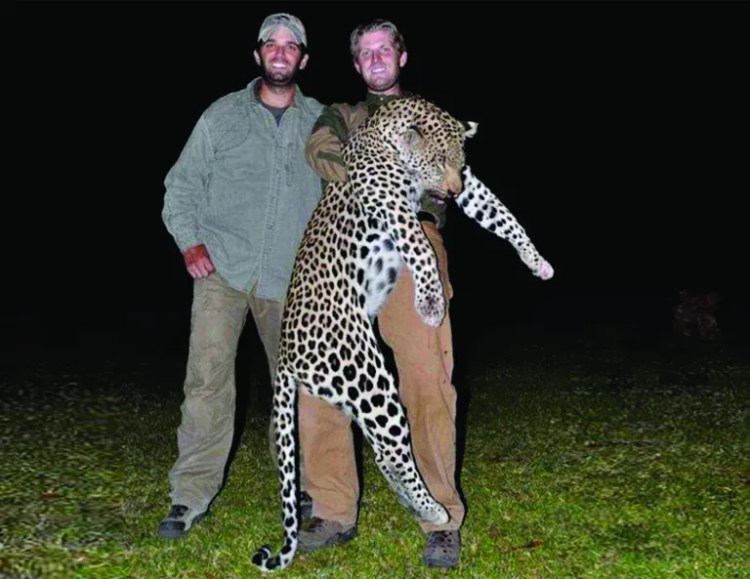
What’s a Leopard Man? Insecurities loom large. A childhood laden with selfish characteristics – spoiled, irresponsible, self-centered, petulant – becomes an adulthood of want. Trophy collection becomes the priority. What did Donny, Jr., and Eric do with the leopard? According to the reportage, the hunt occurred in Zimbabwe and they donated the dead animal to a nearby village. As Donny, Jr., explained on his Twitter feed, the villagers “were so happy for the meat which they don’t often get to eat!”
The exclamation point belonged to Donny, Jr. So did the framing. The Trump boys are providers!
Note the lack of awareness in Donny, Jr.’s statement, the violent form of recreation, the blatant disdain for the ecosystem, the complete deafness for the sanctity of life. Not only are the Trump boys Leopard Men but they are Def Leppard men, too. Reportage describes the loud blasts of Pyromania thumping from a sound system during the hunt.
What did the young Abraham learn from his father? He, too, learned the role of the absent man. Mary Todd Lincoln, or MTL for brevity’s sake, gave birth to her first son in 1843. When Robert Todd Lincoln tumbled down MTL’s birth canal in Springfield, Illinois, he had no idea the culture that awaited him. MTL co-created a household of many jealousies. Abraham Lincoln, meanwhile, worked the law circuits of Illinois and Indiana. He was away, always traveling. MTL, who had a close relationship with her own father, grew increasingly frustrated with her husband during those days. There was talk of separation.
Then came a second son, Eddie, who died four years later, and sons Willie and Tad, and Abe Lincoln became homebound. Proximity led to his presence in the younger sons’ lives, to devotion, to affection, to indulgence. Lincoln evolved. As I documented in Trump-a-Lincoln-a-Lago, Lincoln gained a moniker, and a depiction. Lincoln the softie. Lincoln the jungle gym father. Lincoln the elm tree climbing father. An eyewitness reported the scene, as Willie and Tad and Abe climbed the “famous elm,” then on the lawn of the White House. Unfortunately, there are no photographs of those climbs. And even more unfortunate, that elm tree met a sad ending. It stood where the current West Wing does. Theodore Roosevelt personally chopped down the tree, or at least he made the first cut. He then enjoyed a roaring fire. TR was a Leopard Man.
In Lincoln the elm-tree-climbing father, Willie and Tad received their father’s approval, and fun. Eldest son Robert only received Lincoln’s approval once, when he went off to Harvard. The historical record recognizes a proud Lincoln, pleased that Robert would become the first in the Lincoln line to graduate from college. Robert, according to the historical record, graduated from Harvard. He immediately entered Harvard law school. He dropped out to fight in the war. He never returned to Cambridge. He rode the Lincoln funereal train back to Springfield.
But the history of a proud Lincoln washes over the rift between father and son. For his part, Lincoln acknowledged the rift. He acknowledged his absenteeism, and the cavern it created. “The subject of Rob,” as Lincoln and MTL called the rift, became a talking point in their marriage. Lincoln told MTL that he wanted to repair the relationship. He told MTL that he’d inadvertently re-created the relationship he had with his own father, minus the alcoholism and physical abuse. He’d re-created the unavailability. He told MTL that he’d tried for reconciliation, but Robert rejected all efforts. MTL preached patience. The years, she responded, would soften Robert’s feelings of rejection. The years would lead to mending.
There would be no mending. The events of April 14-15, 1865 happened. The historical record describes the adult Robert Lincoln as the Victorian gentleman: staid, proper, supremely cultured, unfunny. Notably, he became the opposite of his father.
4) Donald Trump did not evolve. From his father, he learned all about emotional distance and enduring efforts of estrangement. As a father, he aped the Fred Trump model. I am witness. As someone who has spent a few hours with the family, I have seen the Trump psychology up close and personal. All of those Trump kids have massive insecurities. At the core lies the morass of unavailability.
Let’s focus on the daughters. As this profile documents the differences between Trump and Lincoln, a focus on Trump’s daughters makes good sense. Lincoln didn’t have any.
Tiffany Trump flirted with me during my evening in Trumpland. As I perceived the flirting, TT has significant daddy issues. She yearns for approval from her father. What does she receive? Either months of silence, or vociferous body shaming when he does acknowledge her presence.
What does that behavior provoke? TT seeks out approval from older men. I will make a prediction. TT will marry someone her own age to satisfy her father’s wants – and, in fact, she announced her engagement on Inauguration Day 2021, even before her father flew away – but TT will have flirtations, and affairs, with older men. In fact, she will do what her grandmother did not. Notably, her sex life will ape her father’s in some significant ways. Will the sex heal the psychic wound within?
The psychic wound within segues to Ivanka. As I described in Trump-a-Lincoln-a-Lago, Ivanka might just be the phoniest person on the planet. At one point during my dinner in Trumpland, Ivanka talked about the wonders of her religious conversion. She spoke with the halo of an angel. She spoke with the naiveté of a princess. Perhaps that’s why her stepmother – sitting at the same table and, arguably, the second phoniest person on the planet – mocks Ivanka as a princess.
I have another word. Around the time of my dinner date in Trumpland, I happened to be reading Leo Rosten’s The Joys of Yiddish. In those pages, I stumbled upon a great description for Ivanka. Trombenik. Rosten defined the word as “a fake, a phony, a four-flusher.” I suppose Rosten played Poker. He continued, “A trombenik is part of the raucous gallery of nudniks, shleppers, and paskudnyaks.”
I’m not sure there’s a better description of Trumpland anywhere else, in any language. But it gets better. Here’s how Rosten defined paskudnyak: “contemptible, rotten, insensitive, petty and – in general – opprobrious.”
Like daughter, like father. As the byproduct of the Donald and Ivana Trump, nee Zelnickova, Ivanka is all pretense, and a terribly lost soul. Let’s be real. Ivanka grew up in the most body-shaming family in America, arguably. As a younger person, she struggled to look at herself in the mirror without feelings of revulsion flooding her thoughts. She turned to plastic surgery as a healing mechanism.
5) A notable event occurred on June 1, 2020. Donald Trump walked out of the White House. He headed due north, across Pennsylvania Avenue, through Lafayette Square, and over H Street. He parked on the sidewalk outside one of Washington’s most iconic institutions, St. John’s Episcopal Church. He did not go inside to pray. Instead, he held a photo opportunity. He wanted to project… what? Confidence? Command? Security? Greatness? Swagger?
Let’s focus on that last descriptive. In his striding from White House to church, Trump, being Trump, swagger-walked. What’s the Trump swagger-walk? Shoulders raised. Sightline fixed on the horizon. Jawline set, and threatening. Puffed out chest.
All sorts of news outlets carried the swagger-walk live and the viewer could see the effects of age on the man. Old age, poor lifestyle, and physics have turned his posture into a curve. He strained to roll his shoulders upright and outward.
Here’s what got lost in the Trump swagger-walk. In 1861, President-elect Abe Lincoln made a similar walk, curving around the eastern perimeter of the White House, passing through Lafayette Square, crossing over H Street to St. John’s. Lincoln slow-walked the route. This was his way. Slow-walking, or slow-riding his horse, gave Lincoln those crucial moments of observation. He could survey. He could study. He could step outside the trappings of his office. He could think, and dream. He could create.
Unlike President Trump some 159 years later, nobody followed Lincoln’s movements. A February morning, cold and sunny, the quiet of a Sunday, the first day of Lincoln’s presidency in the capital city. Nobody recognized Lincoln. Most Washingtonians had never seen Lincoln in person, and certainly not a Lincoln with whiskers on his face. He sat in a church pew and listened to the reverend go about his paces.
Some 159 years later, Trump didn’t enter the church. Nor did the White House alert the rector or any of the Church elders of the planned visit. Trump, in fact, broke with a long-standing tradition. Beginning with James Madison, all presidents made the journey from White House to church. All presidents entered the great house of prayer. All presidents parked themselves on a famed bench, known as the presidential pew. Donald Trump abandoned the tradition. He swagger-walked. He held a photo opp.
Let’s be real. Abe Lincoln, in his wildest imagination, could not have imagined that such folly could take place. Although St. John’s was not Lincoln’s official church in Washington, he made the slow-walk many times. He didn’t sit in the presidential pew. Lincoln, being Lincoln, sat in a back pew. He entered just after services began and he left just before services ended. In those moments, the church became his refuge. He could observe. He could survey. He could step outside the trappings of his office. He could sit there, alone and unnoticed, and listen to the sonorous voice of the reverend. He could dream.
 The American Slaveocracy Revealed