I am up early. I never sleep before a long hike. I’m nervous, busy. I want to be on the road before sunrise. I want to be at the trailhead first. I want to be alone. I spend the night before constantly looking at the clock.
Yes, I own an old-fashioned alarm clock. Big, bright, red numbers. I have to face the clock away from me when I sleep. I even have a smaller version for travel. Both batteries operated.
I get out of bed as the big, bright, red number turns four. I walk the few steps from the bed to the bathroom. I have flown from my home in Brooklyn to my father’s home in Colorado for Thanksgiving – the second Thanksgiving in the Age of the CoronaVirus, or ACV. The consequences of the virus, so authoritative and commandeering, call for multiple capitalizations, or Latin to properly describe the impact. The Latin phrase would be a novus ordo seclorum, or a new order for the ages. I’ve opted for the acronym.
I am unfamiliar with the terrain between bedroom and bathroom. I stub a toe on the bed frame. I hold in my hurt. Though downstairs and therefore removed from my father and his wife, sleeping in a bedroom directly above, I tighten the muscles in my hands into fists, as if that action offers some kind of relief against the pain in my toe. It works, sort of.
I enter the bathroom. I empty my bladder. Miraculously, here in my middle age, I can still make it through the night without a sortie to the toilet. My father tells me that he awakes every three hours to use the bathroom. Simple math then suggests my future: two or three trips during the run of the night hours. I can’t say that I’m looking forward to it.
I brush my teeth. I walk back into the bedroom, careful to avoid the bed frame. I make the bed. I walk up the stairs and into the kitchen, as quietly as possible. Fortunately, carpet covers the floor plan, stairs included. I can’t even hear myself. I turn on a light to make coffee. I trek back down the carpeted stairs. In the guest bedroom, I pack a few last minute items.
I am back up the steps and out the door, ever so quietly, and standing at the rental car around half past the hour. It’s cold. It’s quiet. I look up. An incredible array of stars fills my field of vision, and well beyond. My father lives in a secluded neighborhood at high altitude and it’s relatively dark. Only an outside house light, sporadic streetlights, and the glowing moon, illuminate the surroundings. Fortunately, there are no bed frames to stub a toe.
I enter the car with a bygone model foremost in mind. I don’t own a smart phone, or a mobile phone of any kind. I didn’t map out my route this morning. I steer by the stars. I am a throwback to the 15th century, to the age of seadogs. Maybe an ancestor served as a navigator on board one of Columbus’ ships? As a boy, I placed myself on La Santa Maria, the flagship guiding Columbus and party across the ocean. I always stood high on the central mast, with hand over eye, searching for best shipping lanes. I remember a biography on Columbus. I remember the painting.
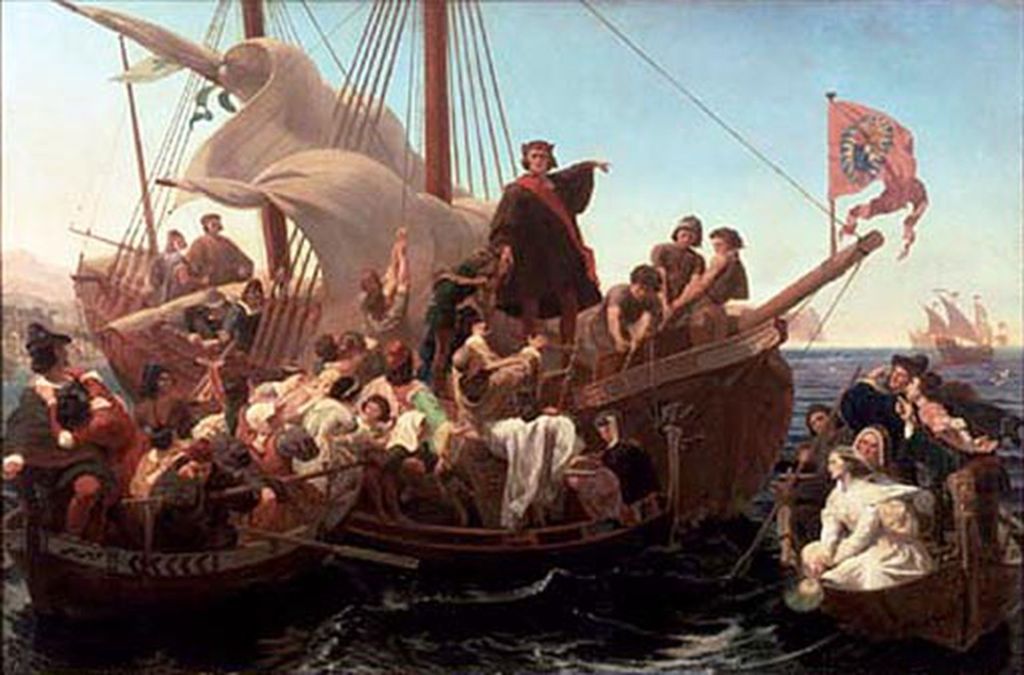
In my mind, I pictured what wasn’t there – the height of the masts. In my mind, I climbed the tallest mast. That got me closer to the stars. I could navigate. I had a vivid fantasy life.
I buckle the seat belt and turn on the engine. I throw the car into reverse and touch the accelerator. I have planned out the day, roughly. I have picked a hike that I’ve known since childhood. I know the road to take, basically. Admittedly, the road might have changed since my last visit, some 45 years ago. I figure that I’ll make the necessary adjustments en route.
As a boy, on top of that tall mast above the hull of La Santa Maria, I imagined the storms coming in. I imagined the stars as guideposts, disappearing from view. I imagined navigation by instinct.
Here’s what we know that I most certainly didn’t know as a boy. There were conversos aboard that ship. Columbus himself may very well have been a crypto-Jew. Given his suzerain, Queen Isabella and her pan-Catholic convictions, he couldn’t have been a Jew outside his quarters. Only within, with dire consequences if discovered.
As a boy, I opted for soccer over a bar mitzvah. My parents went along. I was a Jew in skin only. Maybe like Columbus? I didn’t know about Abraham, Isaac, and Jacob. I didn’t put any stock in Moses and Sinai. I didn’t have a Jewish education. I had a public education. But it dawns on me now, as I think about a converso ancestor navigating from high above La Santa Maria. He would become me. I would become him.
I steer the rental car through my father’s neighborhood. I reach inside my pack, beside me on the passenger’s seat, to make sure I’ve packed two pairs of gloves. The rental car thermometer registers the pre-sunrise temperature as 32 degrees, Fahrenheit. I’ve filled my pack with layers of clothing to protect against the winter cold. I have enough food to last the day – a tin of sardines, apples, a mixed bag of nuts, water. I have a plastic fork so that sardine oil won’t stickify my fingers.
I reach a main road. I am unfamiliar with the terrain. I grew up in suburban Denver, some 10 miles to the north. I wouldn’t know that neighborhood anymore. A friend from that childhood street tells me that everything has changed. The world we knew is gone.
I turn onto Interstate 25, northward. It’s weird, about ten minutes later, to drive through that area of town from my childhood. The street names sound familiar but the landscape speaks to modernity. Back in my childhood, during the long run of the 70s and a healthy chunk of the 80s, I-25 was a division line. West toward the Rockies, there were scattered neighborhoods and wide tracks of land, undeveloped. There were working farms. There were horses. There were unpaved roads.
East toward the plains, there were miles and miles of open space. There was, seemingly, a view of Kansas. Only the horizon impeded the sight lines. There’s nobody on the roadway on this early Saturday morning. I drive alone through south Denver. There was a time that I routinely made this drive, from suburban Denver in the south to southern Denver in the north. My parents divorced in the mid-1970s and my father took an apartment near the home. Eventually, he took an apartment in southern Denver. As a teenager, I used to make the drive to my father’s home, with my younger sister in the passenger’s seat. I don’t remember my feelings around that drive. My childhood friend tells me that he hated that trip. That trip took me away from him. We were inseparable, playing basketball on the driveway until bedtime – except, of course, when I went to my father’s apartment. My parents opted for joint custody. They split the week in half.
North of Denver, I veer onto Route 36. That roadway reaches into Boulder. I don’t know the town. I didn’t go to college there. I never became Boulder-centric. My childhood image of Boulder revolves around unpaved roads, Jeeps everywhere, the red roofs of the university, the flatirons west of the highway, an outdoor Shakespeare festival, held every summer. In my memory, my mother took me specifically. Maybe my two sisters were in the car? I specifically remember watching Julius Caesar under the stars. I think I became a critic that evening. Shakespeare kills Caesar early in the third act. The act goes on ad nauseam. The fourth and fifth acts follow. Shakespeare really blew it there. He lost his audience midway through.
I remember my reaction to the terrible storytelling. I stared up at stars. I put myself at the top of a mast, with a view of what was out there. I dreamed of navigation.
Here’s what I remember from those family drives to the trailhead, direction-wise. In southern Boulder I will exit the highway. I am looking for the name of a road with Canyon in it. I remember that much. I am surprised that I remember that much. I didn’t drive when I last made the trek.
The sun makes its appearance known, loudly, shockingly. The sun is a type A personality. So forceful and all-knowing. So commanding. So domineering. I know this: when I find the road with Canyon in its name, I need to turn left, or west, away from the sun. For that, I am thankful.
There it is – Boulder Canyon Drive. I exit the highway. I take a left. I turn down my rearview mirror. The sun disappears from view, but I can feel the warmth on the back of my neck. Boulder Canyon Drive does as advertised, snakes up into the canyon. Some 20 miles later, I reach the town of Nederland.
The evening before, as my father reminisced about hikes our young family used to take in the Boulder area, he voiced directions. Hang a right at Nederland and you are on the road to the town of Ward.
If the directions sound simple, I encounter modern-day enterprise. Nederland has changed, radically. Nederland has become a tourist destination. That means traffic. Rather than an intersecting roadway where Boulder Canyon Drive meets the town, there’s a traffic circle. There are all sorts of ways to go.
Maybe this is what really happened to Columbus and the navigators on La Santa Maria? Maybe some converso, high above the ship on the central mast, saw an oceanic traffic circle? Maybe, as the ship entered the circle, he shouted out the word to exit. What language was spoken on that ship? The Spanish of Queen Isabella’s kingdom? The Italian of Columbus’ heritage? I will tell you what language wasn’t spoken – the Ladino of the converso
. La Santa Maria didn’t remain in the circle long enough. If Columbus had plans to reach the East Indies, as history tends to record, they shouldn’t have exited early in the circle. They exited.
I enter the circle. Instinctively, I pass the first right. I don’t know. It just doesn’t feel right. In the mountains, instinct serves as ultimate guide. As a hiker from a very young age, I am very instinctual. I take the second right. It’s some 10 miles from Nederland to Ward on a roadway called Peak to Peak, but it’s a good five miles before I have confirmation that I’m on the right road. A sign tells of the approaching town, and the turnoff for Brainard Lake. That’s where I’m bound.
I have a recollection. When I first discovered Brainard Lake, age six or so, I played a mind game. My name is Brian, or a misspelled variant of Brain. Add the last three letters to Brian – Brianard. The name struck me. Brianard, Brainard. Brainard, Brianard. I used to repeat the wording again and again during the hike.
I also used to tell myself stories. I hiked to tell myself stories. I didn’t know then that I’d become a writer. I only knew that I felt at home in one place – storyland, fantasyland – with the Colorado Rockies serving as setting.
Five decades later, what has changed? The Colorado Rockies remain my storyland. I still hike to tell myself stories. In fact, I am writing this story as I hike the Pawnee Peak Trail, near the end of November 2021.
I am 54 years old. I only feel truly at home when hiking. I have a rich fantasy life. I had a rich fantasy life when I first did this hike, some 45 years ago. What story was I telling myself on that first hike? How was I able to deal with the interruptions, as my older sister pushed me, accidentally or otherwise, or as my younger sister called out to me to observe come cool ground creature? She was into microbes at the time. She thought she could spot them with the naked eye.
When my father, a pediatrician by orientation and trade, brought home his microscope from the office, it was my younger sister who showed the most interest. “Brian,” she would say, “come look at the microbe.”
She loved that word, I remember. She repeated it again and again. Brainard, Brianard.
I wasn’t into microbes, or the ground-bound creatures on the hiking trail. I was into stories, the feel of words, their intersections and connections. Brainard, Brianard.
My present-day self, remembering back to that first hike on the Brainard trail, puts both of my parents in the scene. Were they? My father holds a photograph of his three children on the Brainard hike. We’re a few years older than we were at the time of divorce. My mother isn’t in the shot. But neither is our beloved dog, a collie named Ruffie, and he had to have made the hike. Maybe Ruffie was no longer with us?
I don’t remember a happy marriage. I don’t remember joy between my parents, camaraderie, laughter, support. I remember screaming and yelling. I remember doors banging in relentless frustration. I remember nasty lawyers. I remember my father moving out of the family house. We ate matzah as we moved my dad to a nearby apartment. I liked to cover the matzah in butter and strawberry jelly. Mainly I ate the matzah to eat the butter and sweet preserves. The matzah was a delivery system. Still, the matzah suggests the date of divorce: springtime.
My buddy from the street helped us move. Did he recognize what he was losing? I would become a part-time resident of the old neighborhood. We would become part-time friends. I never made a friend in any of my father’s neighborhoods. I didn’t venture out. I clung to my dad. In my recollection of that move, my friend didn’t eat the matzah. He wasn’t a crypto-Jew.
When my parents divorced, I turned to a television show for support. Star Trek became my therapist. The year was 1976, or so, and the original series was in rerun. Every weekday afternoon at four, I flipped on the television in my mother’s living room. I put myself on the Enterprise, in the place of Captain Kirk. I toured the galaxies, always on adventure, navigating from the captain’s chair on the bridge, making fateful decisions, somehow escaping from impossible scenarios. I watched the show with my favorite stuffed animal, a monkey. I thought of the monkey as a tribble.
Captain Kirk was the ultimate loner. I’m not sure those who served on that ship ever truly understood his psychology. He wrapped himself in himself. I identified.
I remember a conversation I had with my father shortly after he moved out of the family home. This is important, I think. This history maps out my psychology at that time, and now.
Let me correct. He remembers the conversation. He tells me the story on Thanksgiving, the first time we’ve seen each other in two years given the ACV. My father is on the verge of his 83rd birthday. His memory is strong. He remains a very astute psychological observer. We still go hiking together. Let me first offer some background. When we were a young family, my father broke away from pediatrics. This couldn’t have been easy for him. He had a family to support – two homes, one of which he didn’t live in. His identity was wrapped in the study and practice of pediatrics. He was pediatric-centric. But my father wanted to become a pediatric psychiatrist. He quit his job and entered a program in southern Denver. He left his apartment in suburban Denver and took an apartment in southern Denver. He moved farther away from the family home.
Let’s get back to my conversation with my dad, as he remembers. In his recollection, we were walking the neighborhood. One block removed from our street, to the east and our view of Kansas, there was a big hill. In my mind’s eye, we were walking up that hill. Maybe we were walking down? My father remains directionally challenged. Like the navigators aboard La Santa Maria? This is my dad speaking, as he remembers the conversation from some 48 years ago. Dad, he has me say? Dad, are you going to move to another state?
A father of another friend has just moved to California. I don’t remember much about my friendship with that boy but I can tell you this: he felt abandoned by his dad. I did, too.
If abandonment is your true marker and you’re a kid of the 1970s, you turn to Star Trek. You put yourself on the bridge of the Enterprise. You identify with Captain Kirk. You imagine your stuffed monkey as a tribble.
It doesn’t go unnoticed now. I had two Kirks in my life. Kirk on board the Enterprise, and Kirk my buddy on the street. Kirk did not identify with Captain Kirk. He did not watch Star Trek. He didn’t need the storytelling for psychological support.
In my father’s recollection of the conversation, he thought that Kirk’s father had moved away. He is wrong. In my mind, Kirk’s father was entirely dedicated to his wife. Kirk’s father, in fact, quit his first love, coaching basketball, to enter the field of real estate. The family of three boys needed a better financial structure. He did what he had to do.
My father quit his pediatrics practice to enter a psychiatry residency. The residency paid him peanuts. I remember my mother, constantly nagging my father for more money. Maybe I’ve used the wrong word? “Nagging” presents my mother in the wrong light. “Nagging” makes her irritating. My mother needed a better financial structure.
Kirk’s father quit his coaching gig for real estate. Kirk, who’s worked in the real estate business for years, now volunteers as a basketball coach. My father did not move to another state. But let’s spin this history forward. My father soon quit the psychiatry residency. He realized, or so he tells me now, that he didn’t want to only tend to children in deep developmental distress. He wanted to tend to healthy babies, too. He didn’t mind the cough, or muscle ache. He couldn’t spend his entire life involved in adversity. He had a novus ordo seclorum. Of course, he had a novus ordo seclorumwhen he first quit pediatrics to enter the psychiatric residency program. I suppose we have novus ordo seclora all the time.
He couldn’t find a job to re-enter the pediatrics field. He had a family to support, two roofs to pay for, one of which he didn’t live under. He took part-time action. I remember the incredible stress, on both parents. I remember my mother’s nagging. Then he found a job, and all seemed okay. But that job took him to Colorado Springs, a good hour south of southern Denver. He took an apartment in northern Colorado Springs. I went to that apartment only once. My father lived there for a good year. It was like he had moved to another state.
How did I deal with the abandonment? I watched Star Trek. I put myself on the bridge of the Enterprise. I identified with Captain Kirk.
Let’s get back to my present-day hike. I’ve left out some details. A good hour into the drive, I arrive in Boulder. It’s a Saturday, and the Boulder police have blocked off the highway. I have to exit. As detailed earlier, I don’t know Boulder. I was never Boulder-centric. I start to feel a little anxiety. The sun is just climbing into view and I’m somewhat lost.
Let me amend. Not lost. If you can guide by stars, you are never lost. Unless a major storm appears. There was no storm that day.
Almost immediately, I find the turn onto Boulder Canyon Drive. My anxiety drops away. What is anxiety anyway? Captain Kirk traveled into the unknown. He seemed entirely willing. Maybe that’s why the show speaks so loudly so many years later? He crushed anxiety.
In the small town of Ward, past the Boulder Canyon, past the traffic circle in the town of Nederland, past the ten miles or so on the Peak to Peak roadway, I turn off into the Brainard Lake parking lot. Brainard, Brianard. Nederland, Netherlands. I am assuming that the founders of Nederland, Colorado came from the Netherlands. I am assuming that the town was founded in the 19th century, post Civil War, as a trading outpost. The first transcontinental railroad was only a few miles to the north. I am assuming that the founders made the spelling change because the locals couldn’t pronounce the original name. The hard d rather than the crazy th made the pronunciation so much easier.
My buddy from childhood struggled with a speech impediment. He had a stutter. He really struggled to pronounce the letter k, among other sounds. But conditions in his family home exacerbated his struggle. Five people lived in his family home. Four of them used the k sound in their names.
Kirk and I meet for lunch during my trip to see my dad. We haven’t seen each other in decades, but we immediately fall into a great comfort. I realize that I miss him dearly. He knows me, unlike any other. He doesn’t know the details of my adult life, but he knows the boy who became the man. He knows the navigator who became the writer.
He tells me, during that lunch, that I made him feel “okay,” even while he struggled with his stutter. I made him feel like a normal kid.
I have this realization. Kirk taught me patience. Kirk taught me humility. He was the greatest athlete I’ve ever seen. He was a gazelle when he ran. So fast. So agile. So elegant. But the speech impediment made him feel small, awkward. He felt muted. He didn’t feel muted with me. I gave him the space to work out his words. But you know? He gave me a gift. I learned how to listen.
I immediately encounter a roadblock. At Brainard Lake, there’s a lower parking lot and an upper parking lot, some four miles up and down a hilly road. The upper parking lot leads to the hiking trails. But winter rules are in play. A barrier blocks all traffic from reaching the upper parking lot. Hiking the road is the only way in.
I sort of shrug my shoulders at the difficulty, just as Captain Kirk would. It just means the hike will be longer, by a good two hours. I step out of the car. I begin. It’s cold, hovering in the high 20s. It’s windy. The sky is cloudless, a vibrant Colorado blue, a transcendent light refraction. The moon glows. The stars seem to touch the mountain peaks. I start the hike at something like 11,000 feet in elevation.
I wear a bright orange parka, two pairs of gloves, a ski hat, running shoes. I can’t wear hiking boots due to arthritis. My shoes and socks become wet almost from the first step. There’s snow everywhere. The snow is hard packed, deep in some places.
There’s nobody around. My mind flashes to the flight, from just a few days before. Every seat was taken. I sat in a middle seat, in the very back of the plane. Both my neighbors pushed in on me. A constant parade of passengers used the lavatories. I felt squeezed, tourniquet tight.
Suddenly, I have elbow room. I have acreage. I have isolation. I have quiet. Well, let me amend. I don’t have quiet. Nature is loud. But I am alone in a humanless expanse.
My mind flashes to another scene. I’m suddenly transported back some 35 years ago. Back to where I stand now. Earlier I wrote that I hadn’t been to this trail in 45 years. In fact, I now realize that I came here at the tail end of my teens. I came here with my one true girlfriend. I was immeasurably in love with Lisa. She was immeasurably in love with me. When we broke, five or so years later, so did the immeasurable. I have never been married. I don’t have children. There have been other women, none of them real partners. Lisa was it.
We were years away from our break when we drove the route to Brainard Lake. Notably, we went around the Thanksgiving. In my recollection, there was snow everywhere. The snow wasn’t hard-packed. A storm had just dumped on the area. The hiking trails were not trespassable. There was nobody around. We sort of hunkered down in the isolation of the mountains. Maybe the upper parking lot had been blocked off? Maybe winter rules were in play? Maybe we hiked through the snow from the lower parking lot? I remember the lake. Completely frozen. I remember boot skating on the surface. I was 19 and I didn’t have arthritis. I remember the incredible joy, the freedom.
The year was 1987. The year now is 2021. Lisa lives 3,000 miles away. We talk on the phone around our birthdays. It’s easy to fall into a great comfort. An hour into my hike on the road, I reach Brainard Lake. The name game hits me. Brainard, Brianard. Nederland, Netherlands. The surface of the lake is frozen. I wonder how deep the ice goes. I don’t stop to check. I find the trailhead. I am surprised by the amount of snow. The severe drought has reduced the Colorado snowfall to a coating. Denver, in fact, has yet to see snow this season – a record for the city. But the snow here is hard-packed and plentiful. Other hikers have attempted the trail. I walk in their footprints. It’s really cold. My shoes and socks are wet. My hands, through two layers of gloves, are nearly numb. I hike onward, through a thicket of trees. My mind flashes to that photograph, in my father’s possessions. We were here, some 45 years earlier.
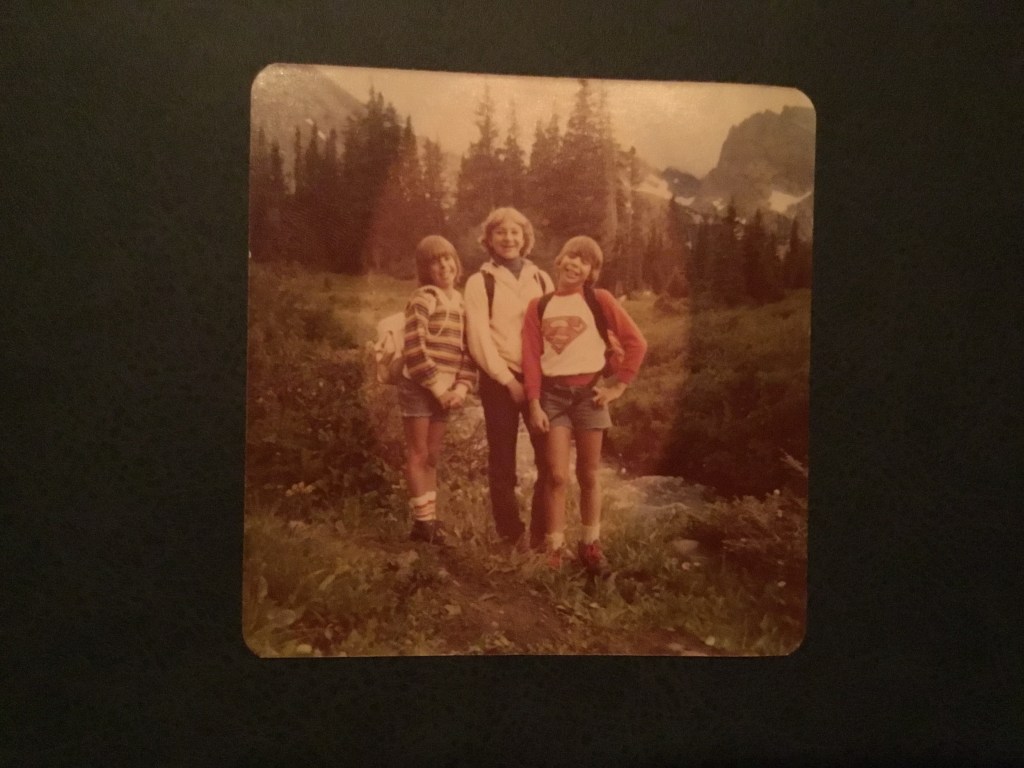
Note the background. There’s snow on the mountainside. There’s a rushing runoff of a river directly behind us. We’re dressed in layers. I’m wearing my favorite Superman sweatshirt, with red arms. My older sister wears pants. She suffers tremendously from the cold. It was a known family detail. There were others. My younger sister refused to eat lamb. I hated peas. My mother wanted to drive a shiny Cadillac. She drove an old Ford station wagon. Eventually the station wagon gave out. She raised what funds she could and bought a used Oldsmobile. A poor person’s Cadillac. I don’t remember her reaction. Her children were thrilled. The size of that car reminded me of the Enterprise.
Note the jean shorts in the photo, cut too high. The style, I suppose, fit the times. Daisy Duke in her cutoff shorts filled a Friday night primetime hour. We would tune in at the end. The Josepher family settled in for the Ewings of Dallas.
Note the light refraction on the three of us. There’s a peripheral darkness. There’s an inner halo. It’s like we’re in some kind of revelation – The Gospels According to the Josephers.
Time has changed the colors and textures of the past. It’s been 45 years since my father snapped the shot. Time has made us all into visitors.
On that hike some 45 years later, I realize that I’ve veered onto an entirely different trail. In the route from the past, a lake connects Brainard Lake, at the bottom, to Lake Isabelle up top. Some surveyor gave that body of water an applicable name – Long’s Lake. The hiking trail skirted the eastern edge for a long time.
Some 45 years later, I’m hiking on a trail significantly above Long’s Lake – maybe 500 feet in elevation. I’m looking down on a frozen lake, surrounded by some shale, surrounded by snow.
My attention goes to the mountain on the other side of Long’s Lake. I have a moment of revelation. Above timberline, I see shale. No snow. The sun hits that mountain face for a good part of the day and the melt is complete. I realize that the same must be true for Pawnee Peak above me.
I hike straight up the mountainside. Leaving behind the trail, packed in snow, but littered with footprints. Trudging up the steep incline, packed in snow, but untouched by footprints of any kind. Breathing hard. My lungs blasting in the altitude gain. I’m used to Brooklyn sea level. Suddenly, I’m nearing 12,000 feet. I play the name game to take my mind away from the gasping. Brainard, Brianard. Brianard, Brainard. Nederland, Netherlands. I’m steps away from the sunlight. I’m hot under my orange parka. I’m sweating under my ski hat. My feet are wet. My fingers are numb.
I reach timberline. I take a step off the snow. It’s my moonshot. I was two years old when Neil Armstrong beamed into our living room. My younger sister wasn’t yet born. The younger version of my family had just moved to Colorado. I am sure we watched that historical sea change, a definitive novus ordo seclorum.
I don’t have memories of watching the moon landing, but I now understand his iconic words. Armstrong wasn’t talking about an incredible breakthrough. He wasn’t talking about progress. He wasn’t talking about the Latin. He was talking about joy and freedom. His age had been freed from the confines of earth. I was free from the confines of snow.
I cross the face of Pawnee, from right to left, if you’re down on the Brainard trail and looking up at the mountain, or the 3 to the 9 on an analog-faced clock. The lakes are below me. Long’s Lake at the 3. Isabelle at the 9. Brainard is out of sight.
I am assuming that Isabelle was named after Queen Isabella of Spain. I am assuming that the surveyors came from Castile. I am assuming that they made the spelling change because the locals couldn’t pronounce the original name. That final la sound is a doozy.
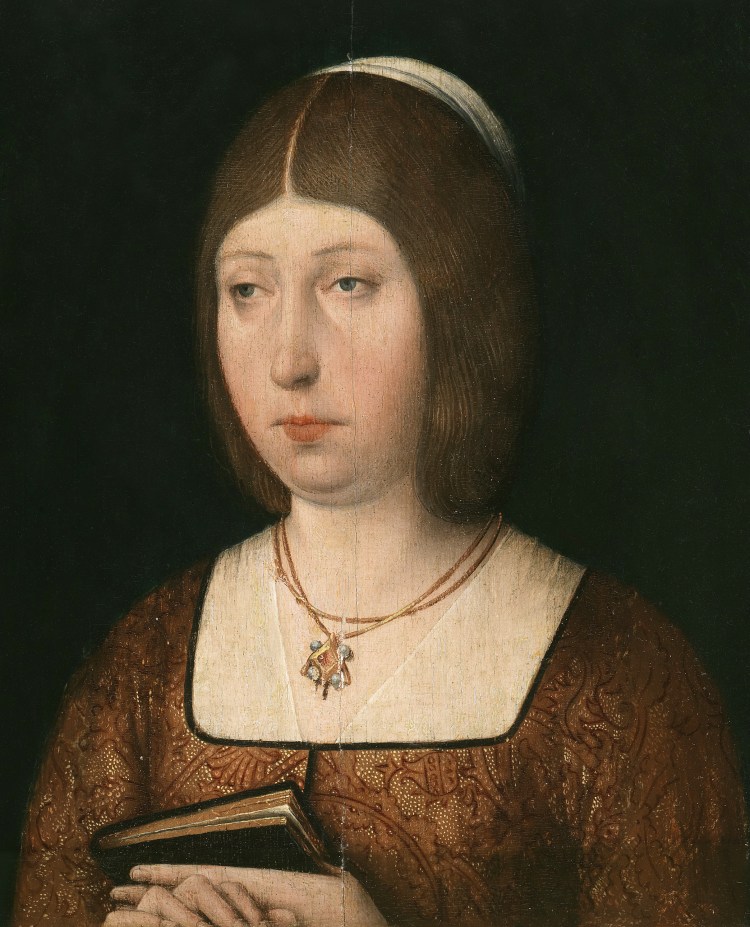
From doozy to dour: look at that face. I get that stern and severe lent an autocratic air. I get that the painter, commissioned by the royals, had to frame the great lady as the ultimate despot – or his body would be burned at the stake. But come on, Isabella. Take a page from the Josepher kids of the 1970s. Give us a glimpse of joy
. Here’s the truth. Isabella followed the guidance of her lead friar and issued the infamous Alhambra decree in March of 1492. Alhambra had one goal: to religiously unify recently unified Spain. Isabella saw the decree as a coalescing. What was the Alhambra effect?
Isabella’s Jews had two choices – exile, or convert to Catholicism. She gave her Jews four months to make that impossible decision. The calendar then suggests that banishment began just as Columbus and his party embarked on their voyage. Maybe the crypto-Jew named Columbus saw his voyage to the new world as a form of exile?
It’s almost impossible to know the numbers impacted by Alhambra, but here’s what we know. Isabella’s lead friar came from Jewish roots. He was a converso!
In Banishment, a migration pattern was born. Isabella’s Jews crossed the border into the more lenient bastions, at that time, of Provence, Piedmont and Genoa. Some put down roots. Some continued the journey, hugging the Mediterranean coastline, coming across the port city of Dubrovnik – where they entered quarantine for a 40-day period, a caution against the bubonic plague, entirely notable here in the ACV – continuing eastward into the Ottoman Empire. A tolerant sultan put out a welcome mat for Isabella’s Jews. The Jews of Spain became the Jews of the Ottoman. The lands of Syria suddenly became Jewish-rich.
But the migration didn’t end there. A secondary migration pattern moved north, into the Russian steppe. Most Ashkenazi Jews trace their origins to Eastern Europe. In fact, Eastern European Jews were once Isabella’s Jews. The Josephers of suburban Denver fall into this category. In fact, we’re Portuguese. Our native language was Ladino. My assumed ancestor, on board La Santa Maria, spoke the language privately, possibly to other crypto–Jews on board. Maybe he spoke the language to Columbus?
Back in Isabella’s Spain, when the Alhambra decree went into effect, the converso population soared. But Isabella wasn’t happy. That dour look defined her rule. She created a police state, known as the Holy Office of the Inquisition. Inquisitors went door to door, rooting out relapsed conversos, known as marranos, or swine. The reference to pig is not lost. The swine were burned at the stake.
Meanwhile, Columbus and his party reached the new world, as they called it. Here’s what Columbus did. He put out a decree to enslave the indigenous population. When we talk about penthouse slavers, with names like Washington and Jefferson, Walter Raleigh and Francis Drake, Columbus belongs in that rung.
Isabella rescinded the order. Why, it’s not like she was some sort of enlightened despot? Maybe she envisioned an entirely new population of conversos? Maybe she saw a vast export for her pan-Catholic convictions? Notably, the Catholic Church would send army after army of missionaries to the new world. Things did not go well for the indigenous population.
Thing did not go well for Columbus, either. The royal court arrested him upon his return to Spain. His punishment for his enslavement decree? He had to walk through a parade of insults on the streets of Granada.
It isn’t lost on me on the face of Mount Pawnee. European explorers, followed by Catholic armies, decimated the Pawnee people. It’s difficult to know the numbers, but the census of 1860 registers 4,000 Pawnee from an estimated 60,000 of a hundred years earlier.
Let’s have one last look at Isabella of Spain.
Dour!
Directly above Lake Isabelle, I look down on ice. I decide to eat lunch. I kick off my shoes and socks. My feet are freezing and the thirty or so minutes in the sun will do my wet shoes some good. I take off both sets of gloves. My fingers are numb. I use the outer gloves for socks on my feet. The second pair of gloves, the liners, basks in the sunshine.
To mentally combat the cold, I play the name game. Brainard, Brianard. Nederland, Netherlands. Isabelle, Isabella. Dour, doozy.
I eat very quickly. A tin of sardines with a fork. An apple. An assortment of nuts, though I munch on the almonds first. A lifelong habit. Gulps of cold water. I fantasize over a thermos of hot coffee. Back when I was a boy, I had a favorite thermos. In my recollection, the screw top was a strange color. Khaki. I loved that khaki-colored thermos. It was my favorite possession, alongside my Superman sweatshirt. Oh, and my Fonzie t-shirt. I wouldn’t let my sisters drink from my thermos.
A bird joins me for lunch. I have seen little wildlife on this journey. Too much snow for ground-bound creatures. Bears in hibernation, thankfully. Too high for moose. The cougars wouldn’t be interested in me.
I throw my apple core near the bird. She flies off with a remarkable prize. I squeeze my cold hands into the liners, now a little warmer from the sun’s glow. Still, I fantasize about hot coffee. What happened to that khaki thermos?
I look down at Lake Isabelle. Are my eyes deceiving me? I see a family, three children with their parents, a collie. They’ve just arrived at the lake. The younger two children, a boy and a girl, are wearing shorts. Daisy Dukes.
Are my eyes deceiving me? At age 54, my eyesight is flailing a bit. I struggle now with corrective lenses, and reading glasses, and contacts drying out my eyes. My optometrist tells me the latter is an effect of ACV. But here, at this spot on Pawnee, I have laser vision. My attention laser-focuses on the family. They remove their provisions from packs. Sandwiches wrapped in aluminum foil. Fruit held in plastic baggies. Loads of napkins. Thermoses. There’s a thermos with a blue screw top. The boy carries a khaki-colored thermos. Weird, I had the exact same model.
The father kicks off his hiking boots. He finds a soft spot on the ground. There’s no snow around. There’s warmth. He stretches out his body. He puts a sweater under his head. He closes his eyes in the bright sunshine.
The older sister walks over to the lake. She doesn’t touch the cold mountain water. She’s the only one of the group wearing pants, and a sweater. She picks up a rock and skips it across the surface of the lake. I count three or four skips.
How many, her mother asks?
Ten, she answers.
What has happened to the boy? Suddenly, I catch a glimpse of his Superman sweatshirt, the red arms. He’s rock-climbing on tall and edgy boulders. He’s incredibly agile, wonderfully balanced, sure of his next move. My laser-focus sharpens ever further and I can peer into his mind. He’s telling himself a story. He looks preoccupied, even as he climbs about. He looks distracted. I wonder if his mind is always away. Processing. I wonder if he plays the name game. Brainard, Brianard. Nederland, Netherlands. Isabelle, Isabella. Dour, doozy.
He looks at me. He smiles a greeting. He can see me? Suddenly, we’re face to face on the face of Pawnee. How did that happen? Suddenly, he’s standing a foot or two removed from me. I shield my eyes with a hand from the slanting sun. The sun’s warmth feels good on the liner covering my numb fingers.
Hi, he says.
Hello, I answer.
Nothing then. Quiet. Well, not quiet exactly. The wind whipping. Echoes of branches being blown around. Rocks falling. Nature is noisy.
I shiver in my orange parka. I wear a ski hat to protect my head. I tug on my socks and lace up my running shoes. I slip on a pair of down gloves over the liners. I shield my eyes from the sun.
He wears cut off jeans, too short. He wears a Superman sweatshirt. He’s sweating. He wears hiking boots. I can’t wear hiking boots, given the arthritis in my feet.
You’re a good rock climber, I tell him. He doesn’t respond. I bet you’re a good athlete, I say. He doesn’t respond. Are you hungry, I ask, after I notice that he’s been staring at the assortment of nuts, residing in a bag on my lap? He says the damnedest thing. You eat the almonds first, he observes. Not as a question. Rather, a statement of fact.
I do, I reply.
I do, too, he says.
We look at each other. I remove the shield of my hand. The sun seems to have shifted. I want to say, I know. I want to say, that will never change. I want to say… there’s so much to say. This is my opportunity to alter his course. I’ve thought long and hard about different paths I would have taken. This is my chance to point him in another direction.
There’s no way to begin. Star Trek forms around a guiding principle known as the Prime Directive. Don’t interfere with the natural development of alien civilizations. Don’t interfere, I mumble to myself. But he is myself. He hears my mumble. Don’t interfere with what, he says. Not as a question. Rather, as a statement of fact.
I smile. I’m not sure why. What does my smile convey? He meets my smile with piercing brown eyes, big and searching. He knows something. He’s way smarter than I thought. I always thought I grew into my smartness in college, when I first opened books, when I made myself available to learning. I always thought I had a revelation, a novus ordo seclorum.
You’re alone, he says.
Yes, I answer.
Have you always been alone, he asks?
There was a time, I answer, looking down on the family at the lake, looking down on sisters and parents and a beautiful dog. There was a time when I had voices in my life, I continue.
What do you have now, he asks?
He’s probing, I think to myself. Does he know what I know? Does he recognize the intersection, the connection?
I have quiet, I answer.
Well, not quiet exactly. In my life in Brooklyn, I am surrounded by noise. The wind whipping outside my window. Street traffic. Incessant car horns. A leaky shower faucet. My upstairs neighbor’s heavy footprints. Life is noisy.
I have this thought then. Let’s spin the rotations of the earth and sun forward some 45 years. Let’s bring the boy to my current age. Let’s put him in my spot, sitting on the face of Pawnee, wearing damp running shoes, an orange parka, a ski hat, two sets of gloves. Let’s also add 45 years to my age. What will I be at age 99? What will the boy, now 54 years of age, say to the man, now 99 years of age, after he somehow reached the face of Pawnee with walking sticks and hip replacements? I can imagine that conversation. You had the chance to tell me everything, the boy, now 54 years old, says. You told me nothing, he says. We talked about nuts, he says.
I always eat the almonds first, the middle-aged man, now 99 years old, says.
So do I, the boy, now 54 years old, says.
Suddenly, he, too, looks down on the young family beside the mountain lake. He sees a boy in a Superman sweatshirt, rock climbing. He sees inside the boy’s head. He sees the stories form. He wonders if the boy plays the name game.
We can hear voices now, the boy and I. Brian, we can hear his parents calling. Brian, we can hear his sisters echoing.
Brianard, Brainard, I say to the boy.
Brainard, Brianard, he says to me.
He leaves then. No words of finality. No last look of understanding. I watch him weave his way down the mountainside. He’s so agile, balanced.
I sit on the face of Pawnee, alone. Shivering in the cold. The Colorado blue overhead, a transcendent light refraction. Snow pack below me. A deserted mountain lake, frozen solid.
I eat the last almond in my bag of mixed nuts. I stand and stretch and decide to hike down to the frozen lake, even if that means hiking back to the car on packed snow.
After dropping 500 feet in elevation, I put a cautious foot on Lake Isabelle. The step feels trustworthy. I take another step. And another. I’m slip sliding across the ice now. I’m skating in joy, freedom.
 The American Slaveocracy Revealed
Nicely done buddy. A lot of insight shown.
LikeLike