My latest book, WHAT WE TALK ABOUT WHEN WE TALK ABOUT (GRANT) BLACK, has just been released. The book can be purchased here: https://www.amazon.com/WHAT-TALK-ABOUT-GRANT-BLACK-ebook/dp/B0DHSMXNWW/ref=sr_1_1?crid=1CPU84P1LC1MU&dib=eyJ2IjoiMSJ9.IZw3Ni2sQDhplGrCnKhK2VFkGNxxXSkF2uPaLr6szivTCOptreIMkR4mWCFs6EWF_KG2vbkQemzeDcazkE33vgxUiOXO9A_D0DKT-lb9CDQwbjuX1v4eRrb6-uXuzGv3pLfu3bPUC9W88doISjgkwg.xTNt1_-m0Ny0JubRZHofNU0cQ3s2p6_V9ogcdSGlwLc&dib_tag=se&keywords=brian+josepher&qid=1729169847&sprefix=%2Caps%2C54&sr=8-1
I am writing a series of related profiles, to be published in this space. This is part I. Part II will examine the ever-changing legacy of Ulysses S. Grant, from Mount Rushmore president to the dregs and, now, to mid-table. Look for “Ulysses S. Grant in the KKK’s America,” coming in November.
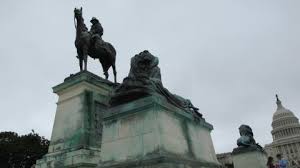
I visited Ulysses in bronze and the wider Grant Memorial in the summer of 2019. Sorry about the distortion. I am a lousy photographer. Here’s what’s important. Real estate records, found in the Office of Tax and Revenue, reveal that Ulysses and Julia Grant once owned a townhouse that sat on this very spot, bordering on Constitution Avenue. Washington remembrance misses this monumental fact.
Here’s what went down. After Julia Grant’s death in late 1902, the Grant offspring performed an unusual transaction. None of the four lived in the townhouse. In fact, they went against the final will and testament of their mother. They didn’t sell. Rather, they donated the property to what is known today as the Architect of the Capitol, or the federal agency tasked with Capitol development, maintenance and remembrance.
I am working on a theory. Perhaps the Grants donated the property in an effort to rehabilitate their mother’s historical legacy? This theory contains a leap in thought. Julia Grant lived a revered life. She was the first truly renowned first lady. The Julia Boggs Grant Salon became the most sought-after invitation in the 1870s. Only the most fortunate got to show up (and out) in the Red Room of the White House on the first Monday evening of every month. She never, however, freed her property, or those slaves who saw to the family’s wants and wonts. The Grant children grew up with slaves as their caretakers. Perhaps they felt damn guilty, and perhaps they realized that impact on their mother’s future legacy?
In the summer of 2020, when reaction to the CoronaVirus created full lockdown mode most everywhere, someone hung a sign just below Ulysses in bronze. “It Could Have Been My Son!!!” the sign read in black and white, and then directly below, “BLACK LIVES MATTER”
Do you know what first caught my eye? Capitalization and punctuation. The three exclamation points ending the first sentence. The lack of any punctuation at the end.
Let’s dig a little deeper, although it is high time to rethink grammar when we talk about slavery and other forms of total decimation. While that first sentence speaks to police brutality, let’s track back to certain African hotspots, anywhere from the 16th century to the 19th century, with the Atlantic slave trade in full tilt and well over 10 million enslaved people shipped to these shores. That sentence could have been uttered by an older mother, after watching her neighbor’s child ripped away by an African state, in conjunction with a European power, shackled by slave traders, force marched to the slave coast, held in dungeons before passing through the “Door of No Return,” then enduring that horrific Middle Passage, and arriving in any one of numerous ports in the U.S., from New Orleans to Charleston to Savannah to New York.
Yes, you read that right! A survey in the London Times in 1860 ranked the New York Harbor as the number one slave market in the world. New York! Where slavery had been outlawed since 1827!
That first sentence has tentacles to this advertisement.
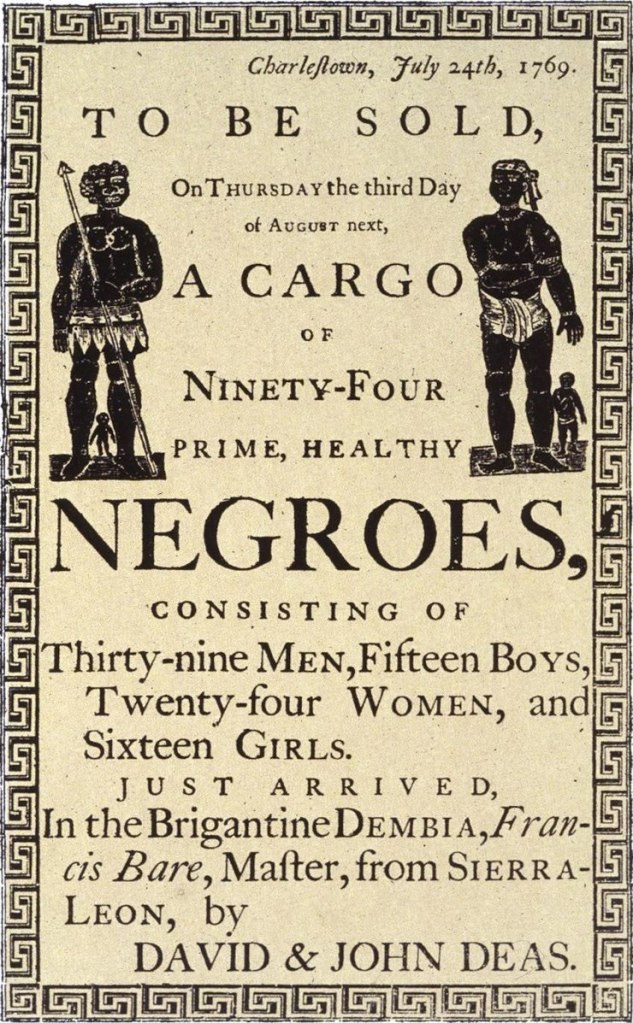
Charleston, South Carolina, 1769. An auction selling “prime, healthy” property called “NEGROES.” Note the capitalization.
In standard writing, from newspapers to magazines to books, that referent for Black people used the lowercase. Only in 1930 did capitalizing the first letter become the standard. 1930, people!!!
Relatedly, the first Black person to outright win the governorship of a former Confederate state occurred in 1990. Douglas Wilder became governor of Virginia. 1990!!!
From 1769 to 1930 to 1990 to 2020. While the sign didn’t last long below bronzed Ulysses, I did a Google search. Never does punctuation appear on any BLM signage. It’s like the organizers are giving the middle finger to English grammar, and with good reason. English grammar is inherently racist. Why do we capitalize the names of slavers, and places where slavery flourished? Should George Washington, for instance, gain capitalization? Should Mount Vernon? Should Charleston? Should the New York Harbor? Perhaps the Grant children understood something of this when they sold the townhouse?
From that penthouse slaver named george washington to a successor, over 225 years later. I know how Donald Trump, in the last year of his presidency, reacted to that sign. Perhaps some backstory is in order here. In June of 2019, I received an invitation in my mailbox. On official letterhead, with the presidential seal and that imposing eagle above all else, the invitation read: “The President and Mrs. Trump request the pleasure of your company for an evening of book talk. Date to be determined.”
“Book talk” referenced my most recent work at that time, as some months earlier I’d published Satan’s Synagogue. Part historical text, part fictional story, an odyssey – or what I call a faux history – Satan’s Synagogue plays with the idea of history. There are traditions out there – Homer, Strabo, Josephus, Solzhenitsyn, Vonnegut, Tom Robbins – where story falls to the wider pastiche of the times. To read and understand these traditions is to value the canvas created.
Incredibly, Satan’s Synagogue became hot news at the Trump White House. This news took weeks for me to digest. I mean, the Trump family reads?!?! And then, the Trump family reads Josepher?!?!
Note the punctuation.
With the shock weakening, gradually, I decided to make the journey to TrumpLand. I didn’t follow the straight route. I wanted to pursue a pivotal question of history never adequately answered. Why did President Lincoln travel to battlefields during the Civil War? Records indicate that he went to Antietam, Gettysburg, Petersburg and Richmond, in order, while those killing fields still smoldered. What was he seeking?
I made my way to TrumpLand by bicycle, sort of at the speed of Civil War armies moving to the next bloody engagement. I made stops at Civil War sites. I gave that ride a title: “A bicycle tour of Civil War Land Central (and peripheral).” That ride, and that historical question asked of Lincoln, formed the central narrative to TRUMP-A-LINCOLN-A-LAGO (TALL). At the time, I didn’t realize that TALL would morph into a series. WHAT WE TALK ABOUT WHEN WE TALK ABOUT (GRANT) BLACK forms the second of a three-part ramble of a road story, movie, odyssey.
In TALL’s front matter, I included a timeline of my bicycle tour. On Day 8 (of 25), I visited the Grant Memorial in front of the Capitol Building. Here’s what’s important. Bronze Grant on his bronze horse – named Jeff Davis – faces west. Notably, jefferson davis hated the shortening of his name. he thought of himself with the pomp, circumstance and authority of that penthouse slaver named thomas jefferson, and nobody shortened the jefferson family name. Or, decapitalized it, either.
General Grant shortened the given name. Out of spite? Irritation? Sardonic wit? Did Grant do irony? The historical record rejects the idea. Grant did direct, unadorned, Ohio talk. He was born in the river town of Point Pleasant, with the slave state of Kentucky on the other side of the Ohio.
Here’s what the historical record reveals. When Grant’s Army of the Tennessee seized the massive plantation of joseph emory davis just south of vicksburg (1863), Grant went to the stables. A stunning black horse caught his eye. He would later purchase the animal from the army. He would add Jeff Davis to his personal horse barn. Later, he would bring Jeff Davis to the White House. (Or, maybe white house is more applicable?) He would board the horse, and other favorites, in the livery just to the west of white house grounds. In those days, there was a horse-racing club on 17th Street, called the Washington Jockey Club. President Grant was a notorious carriage racer. Today, that part of the street houses the Office of the United States Trade Representative, with a Starbucks next door. Because traders need coffee.
Grant owned many horses during the war years: Jeff Davis, Egypt, Cincinnati, Methuselah, who didn’t live into his 969th year, and Kangaroo, just to name a few. But here’s even more of what the record reveals. The plantation owner named joseph emory davis had a (much) younger brother. History knows him as jefferson davis. In the 1850s, davis emerged as a key spokesman for the south in the united states senate. he had access to the men living in the white house. franklin pierce, a foe of the abolitionist movement, even brought davis into his cabinet. Secretary of War davis advocated for the passage of the Kansas-Nebraska Act. That legislation repealed a key concept of the Missouri Compromise. Citizens of territories, rather than congress, would now be allowed to decide their slave status.
The War Department Building lived just to the west of the white house, with the livery just to the south. davis, liked Grant, owned many horses. But he typically rode his favorite to his office in the War Department. That horse was named Jefferson Davis.
Some men name their sons after themselves. davis went with his horse. And a son. he was Narcissus personified.
Eventually, davis returned to the senate, where he would work until the spring of secession. During those years, jefferson davis rode Jefferson Davis to the capitol building.
Note the capitalizations, man, horse, place names, governing bodies. Those pieces of legislation should be decapitalized, too. The truth is, the psychological effect of slavery lives large in our culture. Until we can come to some sort of reckoning, a unification based on equality, our grammar should reflect that inherent prejudice.
Let’s get back to the Grant memorial. The statue of Grant facing west has a universally understood interpretation. Grant faces Lincoln and his memorial on the western edge of the national mall. The universally understood interpretation misses the truer meaning. The direction implies the location of the Grant townhouse. The front door to that townhouse was a step or two removed from the statue. It’s as if bronzed Grant is about to ride into his old home. As one of the great horsemen of the 19th century, Grant could accomplish that feat with eyes closed. Both his and Jeff Davis’s!
By way of jefferson davis – the man, not the horse – let’s segue to Donald Trump and his reaction to the BLM sign. How do I know how Trump reacted? Here’s an anecdote that didn’t make it into TALL. During my dinner with Trump and the first family, the conversation veered toward the BLM. Trump, being Trump, railed at those “cotton-pickin’ squatters. How dare they commandeer federal lands!”
While the exclamation point exploded in my ear, my thoughts went to Trump’s offensive language. Yes, he used “cotton-pickin’” as a stand-in for damn. Not that Trump ever monitors himself when it comes to swearing. The man is profanity unhinged. But the fact that he chose an ugly American referent says something about the man. Apparently it’s better to make a derogatory link to a slave and sharecropper occupation, to belittle those multitudes who were pigeonholed into such difficult labor, than to swear, tamely. Let’s be real. Trump is trump.
But, trump being trump, he completely whiffed on BLM. It took me some time to unpack his meaning. trump didn’t understand that in the modern world, BLM stands for Black Lives Matter. he thought the acronym stood for the Bureau of Land Management. Which it does, too.
Here’s what I realized during my hours with trump. Those movements that heroize the man have their roots in the early postbellum. The proud boys’ noise, the alt-right white supremacy, and the maga thunder all form appendages to the lost cause false narrative.
Note the decapitalization of all organizations, based on racism and overall demerit. There’s a direct line between jefferson davis and donald trump. I don’t know if Kamala Harris owns horses, but if she does, she might consider renaming one after the 45th president of the united states.
Here’s what I do know, for sure. donald trump never rode Donald Trump to the white house.
jefferson davis went to jail. In April of 1865, just hours after the assassination of Abraham Lincoln, the Secretary of War, a fascinating man named Edwin Stanton, put out a reward on davis’s head. $100,000 for davis! That’s over four million today.
davis spent two years in Fort Monroe. Upon his release, he went abroad. Because that’s what seditionists did, in the traditions of benedict arnold! davis would later receive amnesty from president andy johnson. he would make his return to mississippi.
Flash-forward nearly 150 years. From traders to traitors. From the “Door of No Return” to the New York Harbor. From the Bureau of Land Management to BLACK LIVES MATTER
Note the lack of punctuation. From earlier seditionists to the 21st century seditionist. How is it that donald trump remains a citizen of this nation after the events of January 6th?
From the 45th president of the united states to the 47th. How is it that donald trump can even run for the presidency, or win? What is wrong with our america?
Note the decapitalizations. Ulysses Grant must be rolling over in his grave beside the Hudson.
 The American Slaveocracy Revealed
Good to know this is available now!
LikeLike